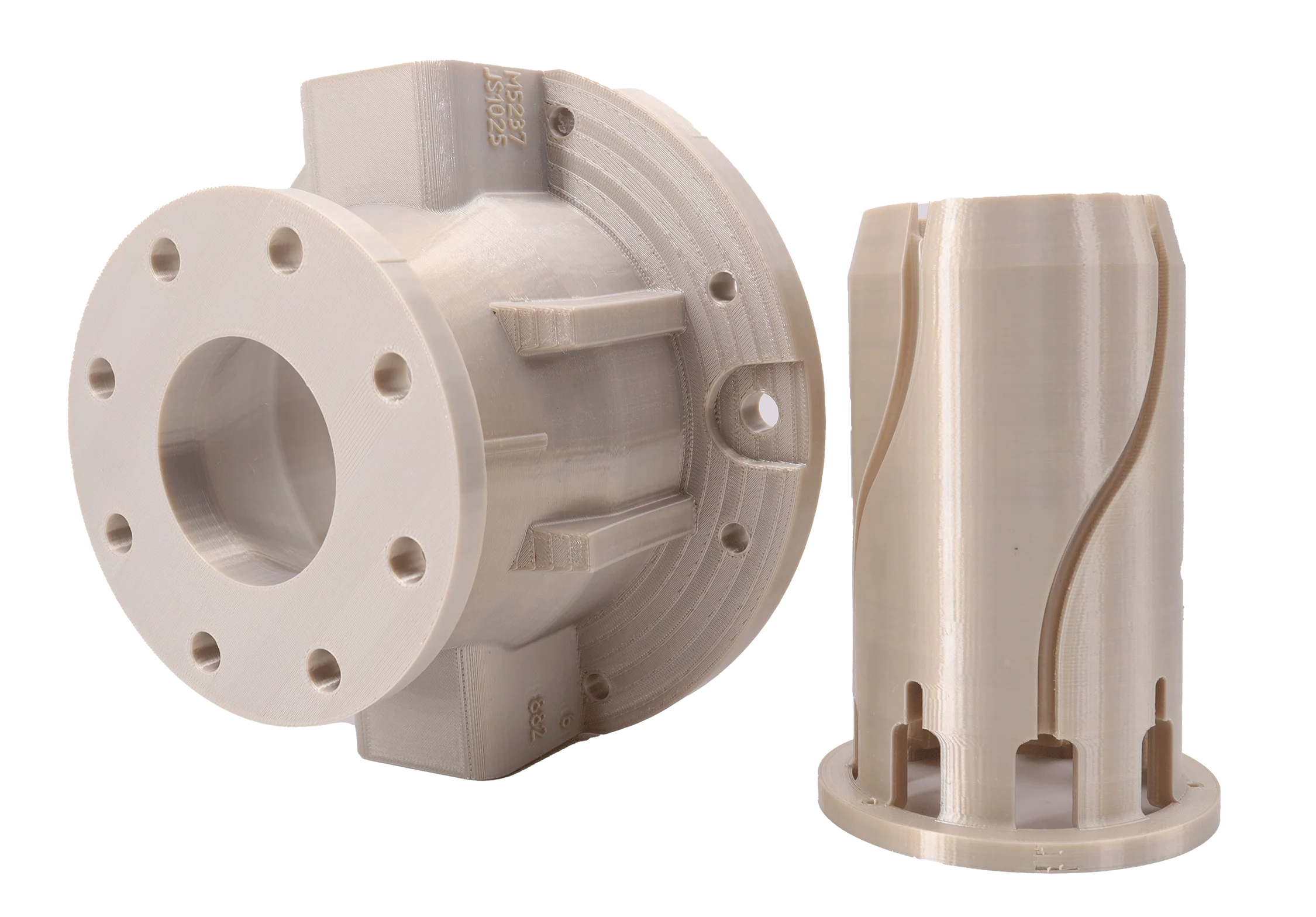
If one design change costs you twelve weeks of machining, you will only ever try one design.
Quick answer: In a feature released on 26 October 2026, Sandia National Laboratories said its CAMINO advanced manufacturing facility supplied 3D printed iterations of a part in one week, against four to six months of difficult machining, and that a team used a printed thermoplastic polyurethane (TPU) surrogate as a mechanical stand-in for a hard-to-machine insulation material. For maintenance and engineering teams in Malaysian oil and gas, the lesson is not to replace the final part. It is to print a low-cost surrogate first, settle fit and design on that, and order the expensive machined part once.
What happened
Sandia National Laboratories, a US national security laboratory, described the work of its Center for Advanced Manufacturing and Innovation (CAMINO) in a feature distributed on 26 October 2026 (Sandia via Newswise), later covered by trade press (3D Printing Industry).
According to Sandia:
- CAMINO is helping Sandia’s Power Sources Technology Group redesign a component by supplying several iterations of one piece part
- making that part conventionally takes four to six months of difficult machining, while CAMINO turned iterations around in one week with additive manufacturing
- in a three-day design sprint, a power sources team developed a 3D printed TPU surrogate that acts as a mechanical stand-in for an insulation material that is difficult to machine, long-lead and expensive to buy
- a photo caption says surrogate iterations took 12 hours rather than 12 weeks
CAMINO manager Mohan Karulkar said the fast turnaround “creates an opportunity to actually experiment with designs.” He was also clear that CAMINO is not a production facility. The printed parts are for design and test iterations, and the real material is still used for the finished hardware.
Why it matters for oil and gas teams in Malaysia
Oil and gas plants, platforms and yards are full of parts that are slow and expensive to make: seats, seals, bushings, wear rings, insulating spacers and housings in PEEK, PTFE, ceramics or exotic alloys. Stock is costly, machining queues are long, and a part that does not fit is often discovered only at installation, during a shutdown window that cannot move.
Sandia’s story shows a simple way to reduce that risk. Three lessons transfer directly:
- Separate the design question from the material question. Most fit, clearance and handling problems do not need the final material to find. A printed surrogate with the same geometry answers them in days.
- Cheap iterations change how you design. When a version costs a day instead of a quarter, engineers try alternatives they would otherwise rule out. Sandia says some ideas were only possible because of this.
- Order the expensive part once. The goal is to freeze the design on surrogates, then release one confident order for the machined or forged part. That protects both the budget and the shutdown schedule.
There is a clear boundary. A surrogate is a stand-in for fit, form and some mechanical testing, not a pressure-containing or service part. Anything that goes into a live process, a hazardous area or a pressure boundary still needs the specified material, the right standard and your company’s approval route. Where a printed part is qualified for service, that is a separate decision, covered in our guide to 3D printing oil and gas spare parts.
From drawing to confident order: the surrogate workflow
Here is how a Malaysian maintenance or engineering team could apply the idea.
- Pick the right candidates. Look for parts with long lead times, costly stock or a history of fit problems: valve internals, seal carriers, insulating spacers, bushings, brackets and covers.
- Get the geometry. Use the OEM drawing or your own CAD. If there is no drawing, 3D scanning and reverse engineering can recover it from a worn sample.
- Decide what the surrogate must prove. Is it fit and clearance, assembly sequence, handling and access in a tight skid, or a rough mechanical check? Write it down, because it decides the print material.
- Print and test. Fit the surrogate in the real assembly or a mock-up. Mark up interferences, tooling access and orientation problems.
- Iterate quickly. Adjust the CAD and print the next version. Keep every revision on record so the final release is traceable.
- Release the final order. Send the frozen drawing to your machine shop or OEM for the part in its specified material. For a cost view of the two routes, see 3D printing vs CNC machining.
Matching the surrogate to the question
| What you need to prove | Material options at Quick 3D | Typical surrogate parts |
|---|---|---|
| Fit, clearance and assembly | PA12 nylons and engineering plastics from our library | Valve internals, bushings, housings, covers |
| Stiffness close to a metal bracket | Markforged continuous carbon fibre | Brackets, mounts, supports, alignment tools |
| Heat or flame behaviour near equipment | UL94 Blue Card materials such as PA12 FR, Ultem 9085 and FR resin | Covers, guards and housings for trial fitting |
| Handling near sensitive electronics | ESD-safe materials such as ABS-ESD7, PETG-ESD and PA612-ESD | Instrument mounts and enclosure trials |
A surrogate does not replicate the chemical resistance, temperature limit or pressure rating of the final material. Treat the table as a guide to testing geometry, not as a substitute for the specified part.
How Quick 3D can help
Quick 3D is an industrial 3D printing service in Shah Alam, Selangor. We print the parts that need paperwork, not hobby parts:
- The largest materials library in Malaysia: 35+ brands and 500+ options, so the surrogate material is matched to what the test needs to show
- Markforged continuous carbon fibre for stiff, lightweight brackets and tooling that behave closer to metal in a fit trial
- UL94 Blue Card and FAA-certified materials, including PA12 FR and Ultem 9085, with documentation for teams that need it on file
- ESD-safe materials for IEC 61340-5-1 programmes (ABS-ESD7, PETG-ESD, PA612-ESD and ESD resin), for parts that sit near instruments and control electronics
- Experience across ASEAN: 100+ customer brands in oil and gas, aerospace, automotive, medical and electronics
Quick 3D was not involved in Sandia’s work. We are print-only: we print to your CAD and material choice and supply parts as printed, without sanding, painting or assembly. Fitment testing, engineering approval and any decision on service use stay with your team.
Frequently asked questions
What is a 3D printed surrogate part?
It is a printed copy of a part, usually in a low-cost plastic, used to check fit, form, assembly or rough mechanical behaviour before the real part is made in its specified material.
Can a surrogate replace the final part in service?
No. A surrogate is for design and test work. Parts for live process, pressure or hazardous-area duty need the specified material, standard and your company’s approval.
How fast can a surrogate be printed?
Many surrogates can be printed in days rather than the weeks or months a machined part can take. The exact time depends on size, material and quantity.
Can you print a surrogate from a worn part without a drawing?
Often, yes. A worn sample can be scanned and reverse engineered into CAD, which can then be printed and checked against the assembly.
Does Quick 3D finish or assemble printed parts?
No. Quick 3D supplies parts as printed. Any machining, finishing or assembly is done by you or your partners.
Waiting months for a part you are not sure will fit?
Send us the CAD file, drawing or a sample part. Our engineers will recommend a surrogate material for the question you need answered and quote print-only production, from a single fit check to several revisions.