We are upgrading our website to bring you a smoother, faster, and more intuitive browsing experience.

Metal (DMLS / SLM) Printing Service

Complex geometries. Solid metal.

Metal 3D printing service

Source high-performing parts for extreme geometric prototyping and low-volume industrial production with advanced Metal 3D printing. We offer a premium metal printing service for mission-critical manufacturing, utilizing a wide range of aerospace-grade alloys tailored for high-strength, heavy-duty use cases. Transform complex files into rugged physical components in as little as 7 days.

Our Metal Capabilities

Extreme geometry. Uncompromising strength.

Redefine the limits of metallurgy. Our metal 3D printing capabilities bypass the constraints of traditional CNC machining and casting, allowing you to manufacture lightweight lattice structures, complex internal cooling channels, and high-strength topologies. Achieve optimal strength-to-weight ratios for your most critical industrial applications.

[wpdatatable id=1]

Metal 3D Printers that we used

High-energy laser fusion. Molecular integrity.

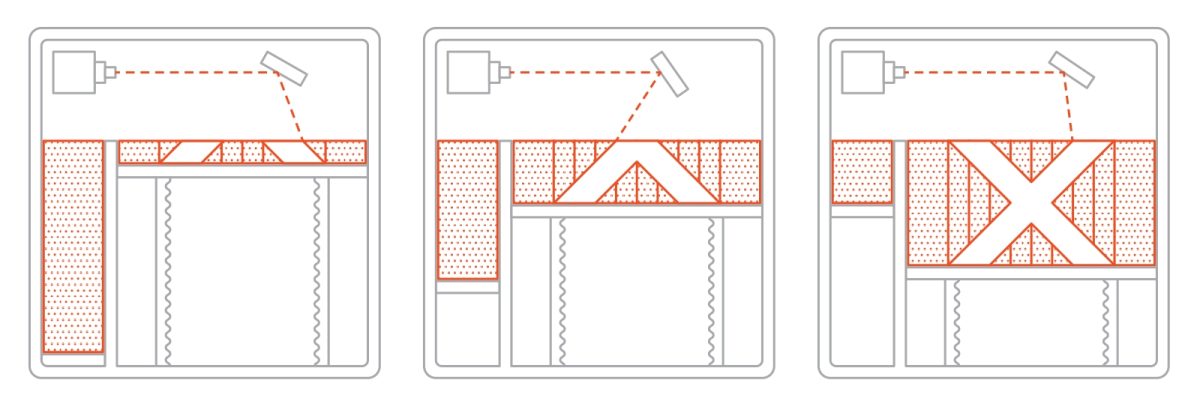
Transforming metal powder into solid structural reality. Our advanced metal additive manufacturing systems utilize high-powered, precision-calibrated lasers to fuse fine metal powder layer by layer under an inert gas atmosphere. This strict process control ensures maximum material density, exceptional crystalline structure, and predictable mechanical performance.

Materials available in our Metal

Industrial alloys. Forged for extreme environments.

Built to withstand the harshest pressures and temperatures. We print using a suite of high-performance industrial alloys, including aerospace-grade Titanium, rugged Stainless Steel, lightweight Aluminum, and corrosion-resistant Inconel. Every material is optimized to deliver maximum structural integrity and field-ready durability.

DMLS Metal 3D Printing

SLM Metal Printing

Materials Documentation

Full technical and safety data sheets

Industries Standard

FAA-approved and industrial-grade materials

Specialty Features

Advanced materials for ESD or High Temp.

Materials Hubs

Incredibly versatile. Exceptionally capable. Designed to perform wherever you need them.

The Metal Gallery

The new state of the art.

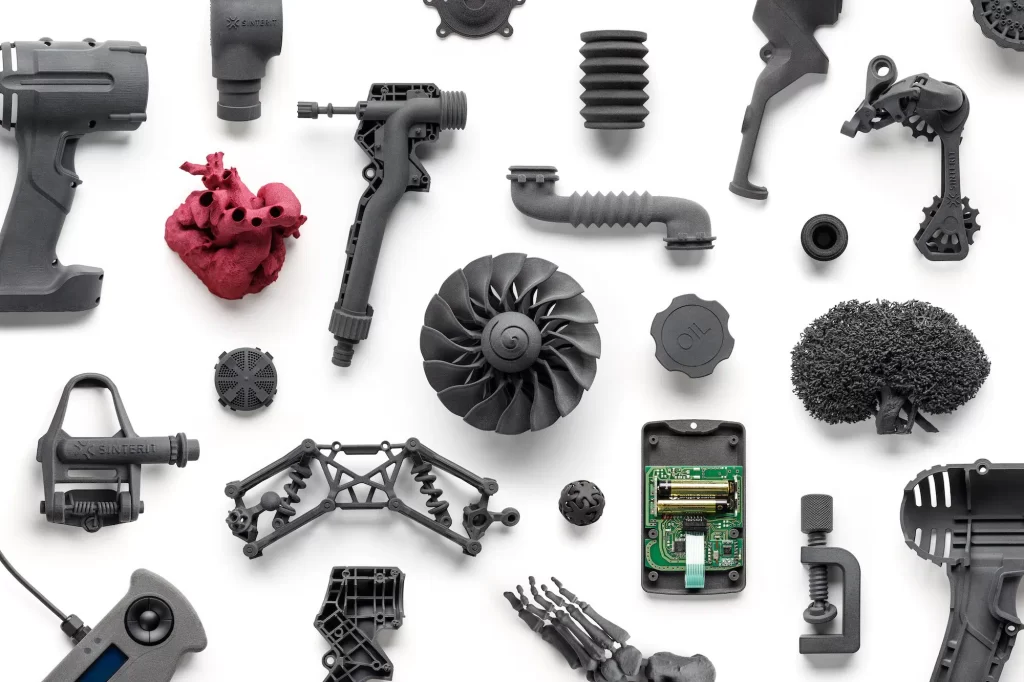
Step into a showcase of heavy-duty engineering. This gallery highlights our capability to manufacture complex, flight-ready, and downhole-certified components that survive where standard parts fail. Browse through high-efficiency heat exchangers, lightweight brackets, and custom industrial tooling built for the world’s most demanding sectors.

Post-Processing for Metal 3D Printing

Metallurgical refinement. Structural perfection.

Forged in the printer, perfected on the bench. Raw metal prints require meticulous post-processing to achieve final mechanical and dimensional compliance. Our advanced suite includes vacuum thermal annealing for stress relief, EDM wire-cutting for precise build-plate separation, and multi-axis CNC machining for tight-tolerance interfaces. We finish every part with automated media blasting or chemical polishing to optimize surface topography and fatigue resistance for critical field deployment.

Take the Next Step.

Share a few details about your project so our manufacturing experts can call you with the right material, cost, and production solution for your business.

Talk to 📞 Additive Manufacturing Specialist now.
SLM vs. DMLS: What’s the Difference?

Technically, SLM and DMLS differ in how they fuse metal particles:

  • SLM fully melts the metal powder, typically using materials with a single melting point.

  • DMLS heats powders to fuse them at a molecular level and is often associated with metal alloys made of multiple elements.

However, for most end-users, this distinction has little practical impact. Both processes produce high-density, high-performance metal parts with similar mechanical properties and applications. As a result, SLM and DMLS are often used interchangeably in industry, and customers typically don’t need to choose between them based on material alone.

Precision MetricDMLS (Sintering)SLM (Melting)
Standard Tolerance+/- 0.1% to +/-  0.2% (Min: +/- 0.1 mm)+/- 0.2% to +/- 0.5% (Min: +/- 0.2 mm)
Warping RiskLower (More stable thermal profile)Higher (Severe liquid-to-solid shrinkage)
As-Printed Surface FinishSmoother, more uniform matteRougher, higher particle adhesion
Fine Feature DefinitionExcellent sharp edges and micro-detailsModerate (Can round off sharp edges)

💡 Engineering Best Practice: Regardless of choosing DMLS or SLM, any critical, high-precision interface (like bearing seats, threaded holes, or sealing faces) should always be designed with a 0.5 mm to 1.0 mm machining allowance so they can be post-processed on a CNC mill to hit absolute zero tolerance.

FDM 3D Printing Services

  1. Dimensional accuracy of +0.5% with a lower limit: +0.5mm.
  2. Lead times from 1 business day.
  3. Materials Available:
  • ABS,
  • PA12,
  • PA6-CF,
  • PA12-CF,
  • PA6-GF,
  • PEEK,
  • PEAK,
  • PPS,
  • PPA-CF,
  • ULTEM® PEI 1010,
  • ULTEM® PEI 9085,
  • PPSU,
  • ESD Series and more…

Stratasys / Markfoged

  • Markforged Aramid Fiber (Kevlar)
  • Markforged Continuous Carbon Fiber
  • Markforged Continuous Carbon Fiber FR
  • Stratasys ULTEM™ 1010
  • Stratasys ULTEM™ 9085
  • Stratasys PPSF/PPSU
  • Stratasys PC-ISO
  • Stratasys ABS-ESD7
  • Stratasys ABS M30
  • Stratasys PC-ABS
  • Stratasys PC-ISO

*The ULTEM™ and 9085 trademarks are used under license from SABIC, its affiliates or subsidiaries.

*Stratasys® are registered trademarks of Stratasys Ltd.

*Markforged® are registered trademarks of Markforged Inc..