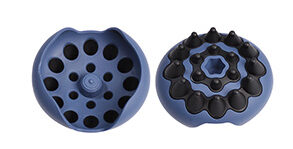
How silicone moulding works
Silicone moulds capture every detail of a master shape and release cast parts easily, so they are ideal for food products, craft and industrial casting, and small production batches. We follow every phase of the project — from design and the master pattern to the finished mould.
Step 1Design and master
We design the shape with you, or work from your CAD file, and 3D print a smooth, accurate master pattern.
Step 2Pour the silicone
Liquid silicone — tin-cured or platinum-cured, soft or firm — is poured around the master and left to cure.
Step 3Demould and check
The cured mould is released from the master, trimmed and checked for detail and fit before delivery.
What our silicone moulds are used for
From chocolate shops to factories, silicone moulds turn one master into many identical cast parts.
Chocolate and confectionery
Food moulds for chocolate, cake, pastry and confectionery brands. See food-grade moulds.
Soap and candles
Moulds for soap, candles and wax products with crisp logos and textures.
Plaster and resin casting
Moulds for plaster, concrete and resin parts, models and decorative items.
Urethane casting
Silicone tooling for casting small batches of plastic and rubber parts. See urethane casting.
Product prototypes
Cast prototypes and samples of silicone and thermoplastic products.
Custom shapes and logos
Branded and custom-shaped moulds made from your own design.
Tin-cured or platinum-cured silicone?
We offer both cure types in soft (15A) and firm (30A) grades. Shore A hardness tells you how soft or firm the mould is — the lower the number, the softer and more flexible.
| Silicone | Characteristics | Best for |
|---|
| Tin-cured 15A | Soft and flexible; lower cost | Detailed parts that need a flexible mould for easy release; non-food casting |
| Tin-cured 30A | Firmer and more durable; lower cost | Larger moulds and simpler shapes; plaster, soap, wax and resin |
| Platinum-cured 15A | Soft, flexible, low shrinkage and long-lasting; food-safe grades | Food moulds with fine detail, such as chocolate |
| Platinum-cured 30A | Firmer, low shrinkage and long-lasting; food-safe grades | Food moulds and moulds that must hold their shape |
Frequently asked questions
What is the difference between tin-cured and platinum-cured silicone?
Tin-cured silicone is lower in cost and well suited to non-food casting such as soap, wax, plaster and resin. Platinum-cured silicone shrinks less, lasts longer and is available in food-safe grades, so it is the choice for chocolate and other food moulds.
Which silicone is food-safe?
Use platinum-cured, food-safe silicone for moulds that touch food. We make food moulds for chocolate, cake and confectionery in platinum-cured silicone — see food-grade moulds.
What do 15A and 30A mean?
They are Shore A hardness values. 15A silicone is soft and very flexible, which makes demoulding detailed parts easier. 30A silicone is firmer and holds its shape better for larger moulds.
Can you make a mould from my design or logo?
Yes. We can design the shape with you, turn a sketch or logo into a 3D model, and 3D print the master pattern used to make your mould. See 3D design services.
Can you copy an existing object?
Yes. We can 3D scan an existing object and use the scan to create a master for a new mould. See 3D scanning.