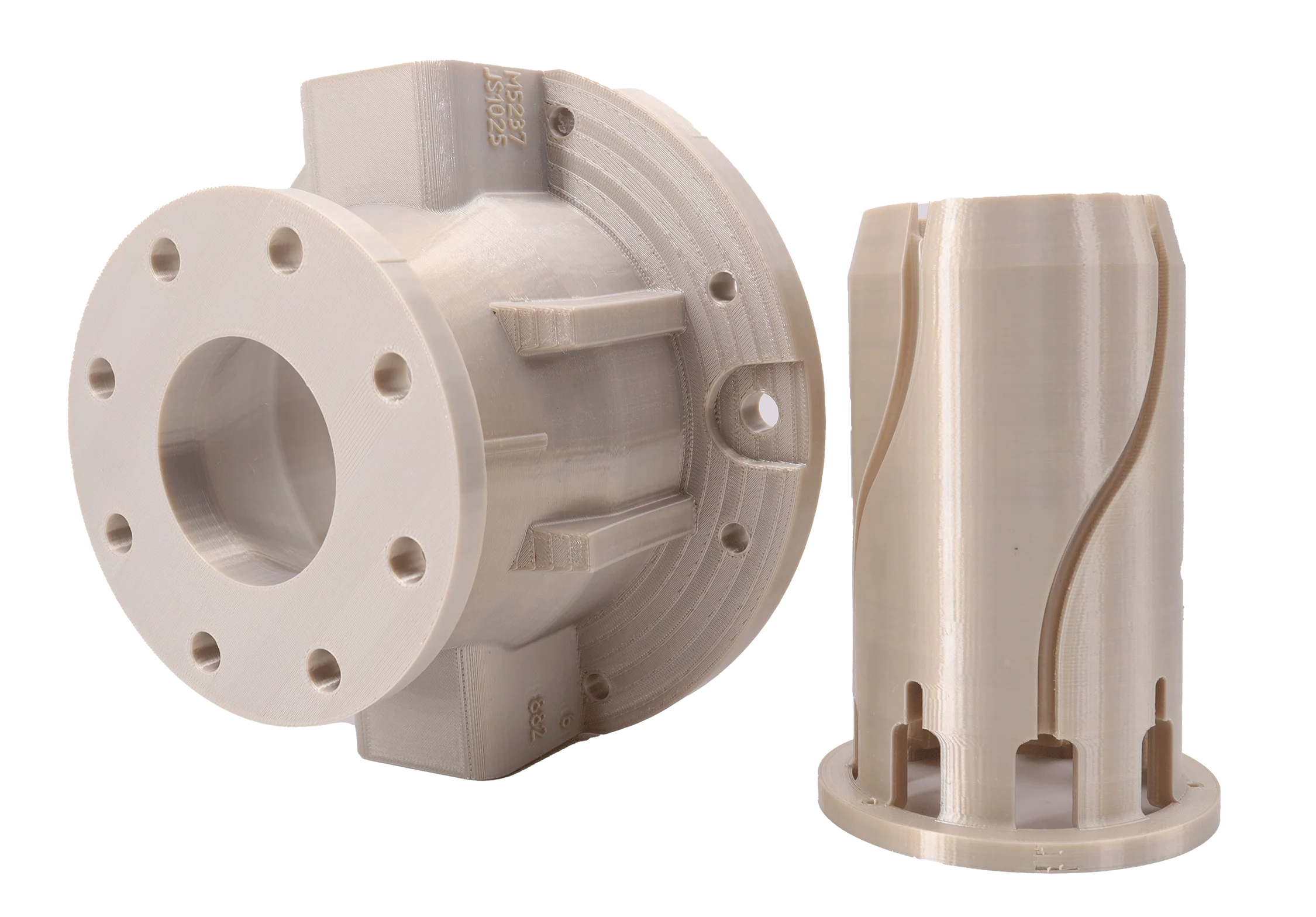
Carbon Fiber & Glass Fiber Materials
Fiber-reinforced materials that print stiffer, stronger and lighter parts — for jigs, fixtures, brackets and end-use parts that often replace machined aluminium.
Benefits of 3D Printing Fiber-Reinforced Parts
Adding chopped or continuous carbon, glass or aramid fiber to a base polymer such as nylon, PET or PPS makes printed parts much stiffer and stronger, while keeping them light and dimensionally stable.
High Stiffness and Strength
Fiber reinforcement raises stiffness and strength, so parts deflect less under load — ideal for brackets, levers and structural components.
Lightweight
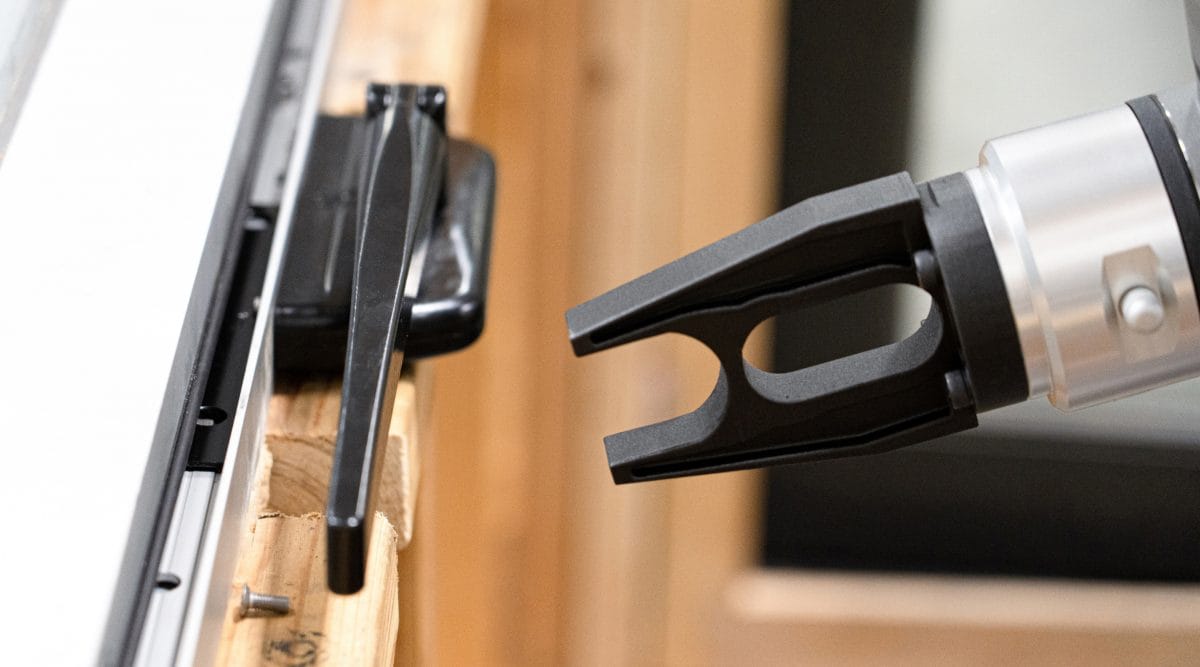
Carbon-fiber parts weigh a fraction of their metal equivalents, which suits end-of-arm tooling, grippers and handheld fixtures.
Dimensional Stability
Fibers reduce warping and shrinkage, so parts hold their geometry for fixtures and repeatable assemblies.
Replace Machined Tooling
Print jigs, fixtures and tools faster and at lower cost than machining them from aluminium — and redesign them whenever the line changes.
Carbon Fiber & Glass Fiber Materials We Offer
Carbon & Glass Fiber Filaments (FDM)
Fiberon™ PA6-CF20, PA12-CF10, PA612-CF15, PET-CF17, PPS-CF10 and Stratasys Nylon 12 CF for stiff, light parts — plus PA6-GF25, PET-GF15 and PPS-GF20 glass-fiber grades for tough, cost-effective strength.
Continuous Fiber (FDM)
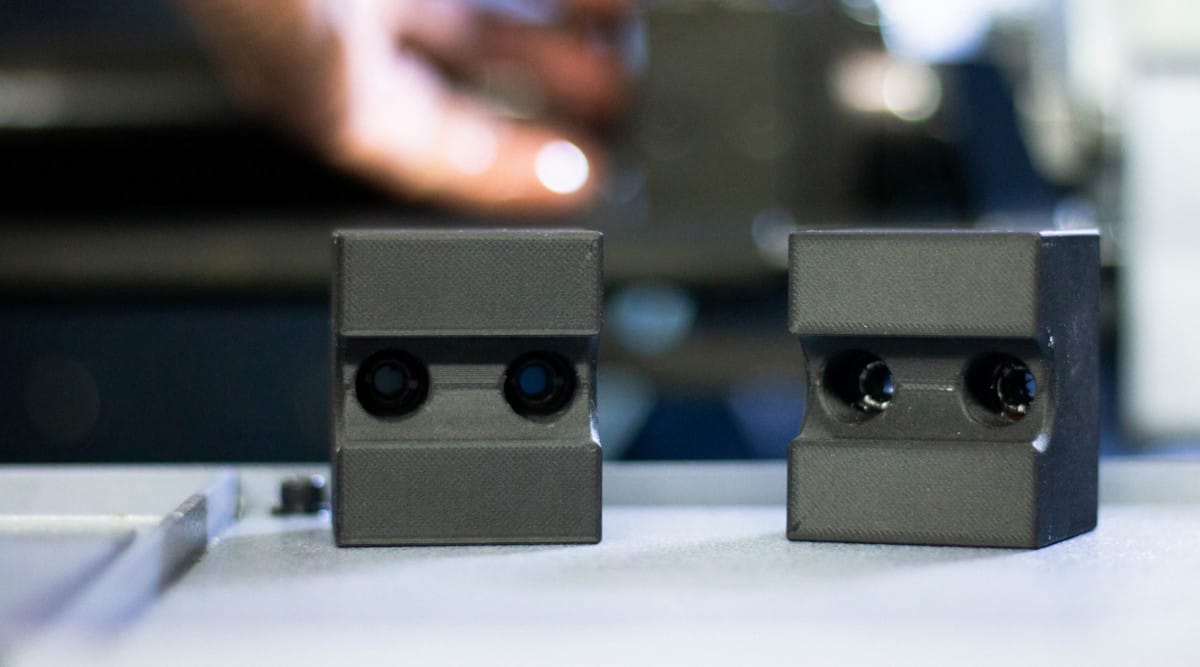
Markforged Continuous Carbon Fiber, Continuous Carbon Fiber FR and Aramid Fiber (Kevlar®) lay unbroken strands inside the part for the highest strength-to-weight — for fixture jaws, levers and tooling.

Glass- & Carbon-Filled Nylon (SLS & MJF)
PA6 Glass Filled, PA12 Glass Filled and PA6 Carbon Filled on SLS, plus HP PA12 Glass Beads on MJF — support-free parts that are stiff and dimensionally stable, for housings and batches of end-use parts.
Materials Finder
Compare stiffness, strength and heat resistance to find the right fiber material.
*Fiberon™, Markforged®, Kevlar®, Stratasys® and HP® are trademarks of their respective owners.
Applications
Fiber-reinforced parts replace metal and machined tooling across manufacturing, automotive, aerospace and oil and gas — wherever a part must be stiff, strong and light.
Jigs & Fixtures
Stiff, lightweight fixtures for assembly, inspection and machining.
End-of-Arm Tooling
Robot grippers and custom fingers that cut payload weight.
Brackets & Mounts
Structural brackets that replace machined aluminium parts.
Fixture Jaws
Custom jaws and nests that hold parts during machining and assembly.
Automotive Parts
Intake scoops, ducts and functional prototypes with internal ribs.
Drone & UAV Parts
Lightweight airframe parts and mounts for UAV platforms.
Levers & Handles
High-stiffness levers and handles for tools and equipment.
Chemical-Resistant Parts
Carbon-fiber PPS components for oil, gas and chemical environments.
Frequently asked questions.
What is the difference between carbon fiber and glass fiber filled materials?
Carbon fiber gives the highest stiffness for the lowest weight. Glass fiber adds strength and toughness at a lower cost and is less brittle. Both reduce warping compared with unfilled plastics.
What is continuous fiber 3D printing?
Continuous fiber printing lays unbroken strands of carbon fiber or Kevlar® inside a nylon part. This gives much higher strength than chopped-fiber filaments, which is why it is used for fixture jaws, brackets and tooling.
Which fiber materials do you offer?
On FDM: Fiberon™ PA6-CF20, PA12-CF10, PA612-CF15, PET-CF17, PPS-CF10, PA6-GF25, PET-GF15 and PPS-GF20, Stratasys Nylon 12 CF, and Markforged Continuous Carbon Fiber, Continuous Carbon Fiber FR and Aramid Fiber (Kevlar®). On SLS: PA6 and PA12 Glass Filled and PA6 Carbon Filled. On MJF: HP PA12 Glass Beads.
Can carbon fiber 3D printed parts replace aluminium?
For many jigs, fixtures, brackets and end-of-arm tools, yes. Carbon-fiber composites are often used to replace machined aluminium tools because they are lighter, faster to make and easier to redesign. We can share technical data sheets so you can compare properties.
Which process should I choose for fiber-reinforced parts?
FDM suits large fixtures and the strongest continuous-fiber parts. SLS and MJF suit complex, support-free parts and batches of end-use parts. Send us your file and we will recommend the best option.
Take the Next Step.
Share a few details about your project so our manufacturing experts can call you with the right material, cost, and production solution for your business.
Talk to  Additive Manufacturing Specialist now.