Learn · Comparisons
SLS vs MJF: Which Nylon 3D Printing Process Is Right for Your Parts?
SLS and MJF both make strong nylon parts without support structures, so they are easy to confuse. Here is how they differ in materials, finish and consistency, and how to choose between them.
How each process works
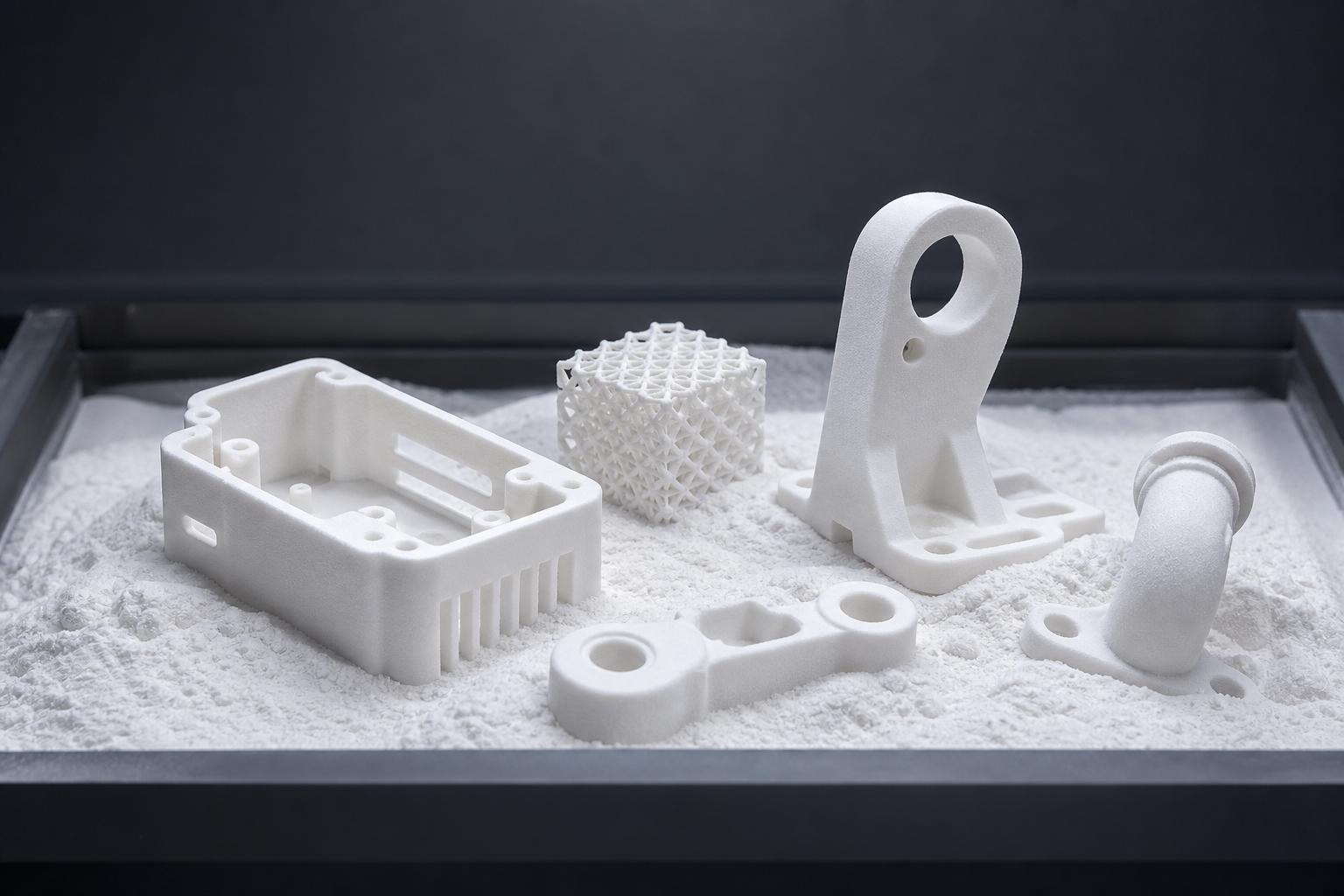
Both processes build parts inside a bed of fine powder. The loose powder around each part supports it as it grows, so neither process needs support structures. That is why both are excellent for internal channels, nested assemblies and complex overhangs.
SLS (Selective Laser Sintering)
A CO2 laser traces each layer and sinters the powder inside a tightly controlled, heated chamber. After printing, parts are de-powdered and bead-blasted. Learn more about our SLS service.
MJF (HP Multi Jet Fusion)
Instead of a laser, an HP print head jets fusing and detailing agents onto each layer of powder, and heat fuses the whole layer at once. Because the entire layer is processed in one pass, MJF produces parts with very uniform, predictable properties across a build. Learn more about our MJF service.
SLS vs MJF at a glance
| SLS | MJF | |
|---|---|---|
| Energy source | CO2 laser | Fusing and detailing agents plus heat |
| Supports | None needed | None needed |
| Materials at Quick 3D | PA11, PA12, PA6 Glass Filled, PA12 Glass Filled, PA6 Carbon Filled, PEEK 5100, polypropylene (PP), TPU, castable polystyrene (PS) | HP PA11, HP PA12, HP PA12 Glass Beads, HP TPU, HP Nylon Full Colour |
| Strength | Strong, durable functional parts | Dense parts with uniform strength in every direction (isotropic) |
| Consistency | Very good | Excellent, batch after batch |
| Raw colour | Usually white or off-white (PA12) | Grey, usually dyed black |
| Finishing | Bead blasting, sanding, coatings, dyeing | Media blasting, chemical vapour smoothing, deep-dye black |
| Lead time | From 7 days | From 7 days |
When to choose MJF
- Production batches. You need tens or hundreds of identical parts that behave the same way, such as clips, housings and brackets.
- Uniform strength. The part is loaded in several directions, for example a snap-fit, clip or bracket.
- Fine features. Small text, thin ribs and detailed interlocking assemblies.
- A dark, consistent finish. Grey MJF parts take deep-dye black well, and vapour smoothing gives a sealed, smoother surface.
- Full colour. HP Nylon Full Colour makes realistic coloured prototypes and models.
When to choose SLS
- A wider choice of materials. SLS offers PEEK 5100 for heat and chemical resistance, polypropylene for chemical resistance and living hinges, and castable polystyrene for investment-casting patterns.
- Extra stiffness. Glass-filled PA6 and PA12 and carbon-filled PA6 are stiffer than standard nylon, which suits brackets and structural parts.
- A light natural colour. Natural SLS PA12 is light in colour, so it can be dyed or painted in lighter shades.
- Large, densely nested builds. Many parts can be nested in one build for efficient batches.
Material by material
| You need | SLS option | MJF option |
|---|---|---|
| General-purpose nylon | PA12 | HP PA12 |
| Tough, ductile, bio-based nylon | PA11 | HP PA11 |
| Stiffer, dimensionally stable nylon | PA6 or PA12 Glass Filled | HP PA12 Glass Beads |
| Carbon-reinforced nylon | PA6 Carbon Filled | — |
| Flexible, rubber-like parts | TPU | HP TPU |
| High-temperature polymer | PEEK 5100 | — |
| Polypropylene | PP | — |
| Investment-casting patterns | Castable PS | — |
| Full-colour parts | — | HP Nylon Full Colour |
Not sure whether PA11 or PA12 suits your part? Read PA11 vs PA12 nylon.
Design tips that work for both
- Keep walls around 1 mm or more. 1.5–3 mm is comfortable for most functional parts.
- Hollow thick sections. Large solid blocks cost more and can warp. Hollow them and add escape holes so unfused powder can be removed.
- Design snap-fits in PA11 or PA12. Nylon flexes without cracking, which makes both processes ideal for clips and snap-fits.
- Send a STEP file. It lets us check wall thickness and features before printing.
See our wall thickness guide and snap-fit design guide for more detail.
Frequently asked questions
Is MJF stronger than SLS?
Both make strong, functional nylon parts. MJF’s advantage is consistency: its parts have very uniform properties in every direction and from batch to batch. SLS offers stiffer options, such as glass- and carbon-filled nylons and PEEK.
Which is cheaper, SLS or MJF?
It depends on the part, material and quantity. MJF is often very cost-effective for batches of PA12 parts, while SLS is the only option for some materials. Send us your file and we will quote both where they apply.
Do SLS and MJF need support structures?
No. In both processes the surrounding powder supports the part, which allows internal channels, nested assemblies and complex overhangs.
What colour are SLS and MJF parts?
Natural SLS PA12 parts are light in colour. MJF parts come out grey and are usually dyed black. HP Nylon Full Colour on MJF can produce full-colour parts.
How fast can I get SLS or MJF parts?
At Quick 3D, SLS and MJF parts can be ready in as little as 7 days, depending on part size, quantity and finishing.
Not sure which process fits?
Send us your CAD file and quantity. We will recommend SLS or MJF and quote your parts.
Get a QuoteWhatsApp Us