
Learn · Industry Applications
Reverse Engineering Obsolete Parts: How Factories Avoid Downtime
When a machine part is no longer made, the line should not have to stop. Here is how factories use 3D scanning, reverse engineering and 3D printing to replace obsolete parts in days.
The cost of an obsolete part
Every factory has machines that outlive their spare parts. A worn gear, a cracked bracket or a broken guide the original maker no longer supplies can stop a line for weeks. Waiting for a new tool, or redesigning around the part, is slow and expensive.
Reverse engineering — capturing the part’s geometry and rebuilding it as a CAD model — combined with 3D printing turns that wait into days.
Your options when a part is no longer made
| Option | Works well when | Watch out for |
|---|---|---|
| Source from the original maker | The part is still available | Long lead times or minimum orders for old parts |
| Machine a replacement | Simple shapes; metal strength needed | Needs a drawing; complex shapes cost more |
| Reverse engineer and 3D print | No drawing exists; complex shapes; one-offs or small batches | Material must suit the part’s load, heat and chemicals |
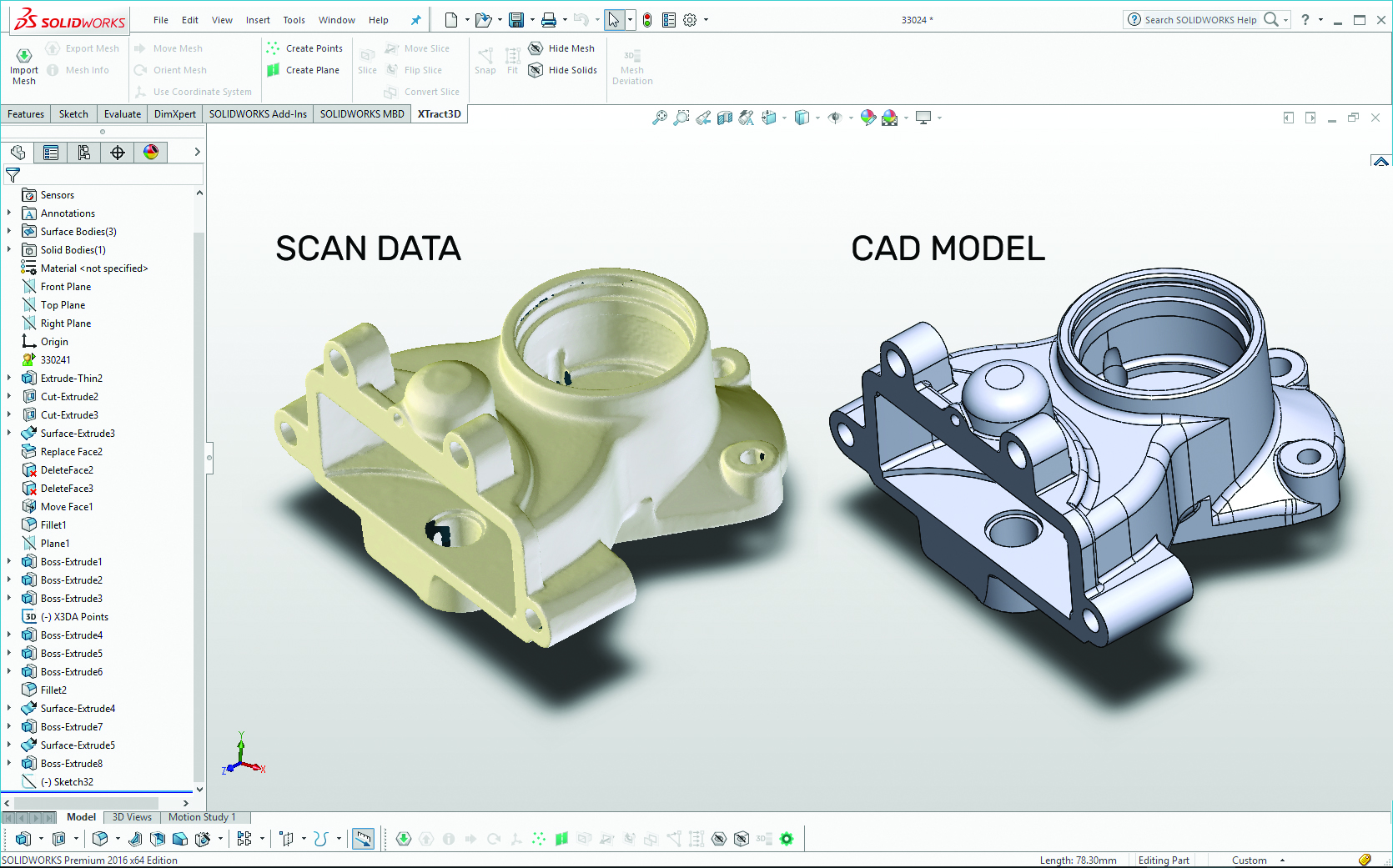
From broken part to replacement: step by step
- Collect the part and its story. Send the worn or broken part — or ask us to scan it on-site. Tell us how it is used.
- 3D scan. Non-destructive scanning captures accurate surface data, even from worn parts.
- Reverse engineer. The scan is converted into a workable CAD model. Worn or broken areas are rebuilt to the intended shape.
- Choose the material. Match or improve on the original using its operating conditions.
- Print and inspect. The part is printed, finished and dimensionally and visually inspected.
- Store the file. Keep the CAD so you can reorder the same part any time.
What to tell us about the part
- Function: what it does and what it connects to.
- Loads: is it structural, a wear surface, or a cover?
- Environment: operating temperature, oils, chemicals, UV or outdoor use.
- Critical fits: bearings, shafts, threads or mating parts.
- Quantity: one urgent spare, or a stock for every machine?
Choosing a material for spare parts
| Need | Materials to consider |
|---|---|
| General covers, guards, brackets | ABS, ASA, PC, PA12 nylon |
| Stiff, lightweight parts | Carbon-fibre nylon, glass- or carbon-filled nylon |
| Heat and chemicals | PEEK, PEKK, PPS, PVDF, ULTEM™ PEI |
| Metal strength or corrosion resistance | Stainless steel 316L and 17-4 PH, Inconel 718 and 625, titanium Ti64 |
| Flexible parts and seals | TPU, or urethane-cast rubber |
More detail in our heat-resistant materials guide.
Build a digital inventory
Once a part is reverse engineered, its CAD file becomes a digital spare. Instead of holding stock on a shelf, you can reorder exactly the same part when you need it — from one piece to production volumes, with no minimum order.
See how this works in practice in spare parts on demand for oil and gas and 3D scanning and reverse engineering, or visit our spare parts and MRO service.
Frequently asked questions
Can you reverse engineer a part with no drawing?
Yes. We 3D scan the physical part — on-site or at our facility — and convert the scan into a workable CAD model, rebuilding worn or broken areas.
Can a worn or broken part still be scanned?
Usually, yes. The scan captures the remaining geometry and the damaged areas are reconstructed in CAD. Sending a mating part or an unworn example helps.
Is a 3D printed replacement as strong as the original?
It depends on the material and process. We can print in engineering plastics, composites and metals, and share data sheets so you can compare with the original.
Can I reorder the same part later?
Yes. We keep the CAD file so you can reorder any quantity, from one part to production volumes, with no minimum order.
Got a part you can’t source?
Send photos, a drawing or the part itself. We’ll advise on scanning, material and cost.
Get a QuoteWhatsApp Us