
Learn · Comparisons
PEEK vs ULTEM™: Choosing a High-Performance 3D Printing Polymer
When a part must survive heat, chemicals or strict fire-safety rules, standard plastics are not enough. PEEK and ULTEM™ (PEI) are the two most common high-performance polymers for 3D printing. Here is how they compare and when to choose each.
What are PEEK and ULTEM™?
PEEK (polyether ether ketone) is a semi-crystalline polymer from the PAEK family, known for its exceptional chemical, wear and heat resistance. Its relative PEKK belongs to the same family.
ULTEM™ is SABIC’s brand of PEI (polyetherimide), an amorphous polymer with high strength, high heat resistance and inherent flame retardancy. The two grades used in 3D printing are ULTEM™ 9085 and ULTEM™ 1010.
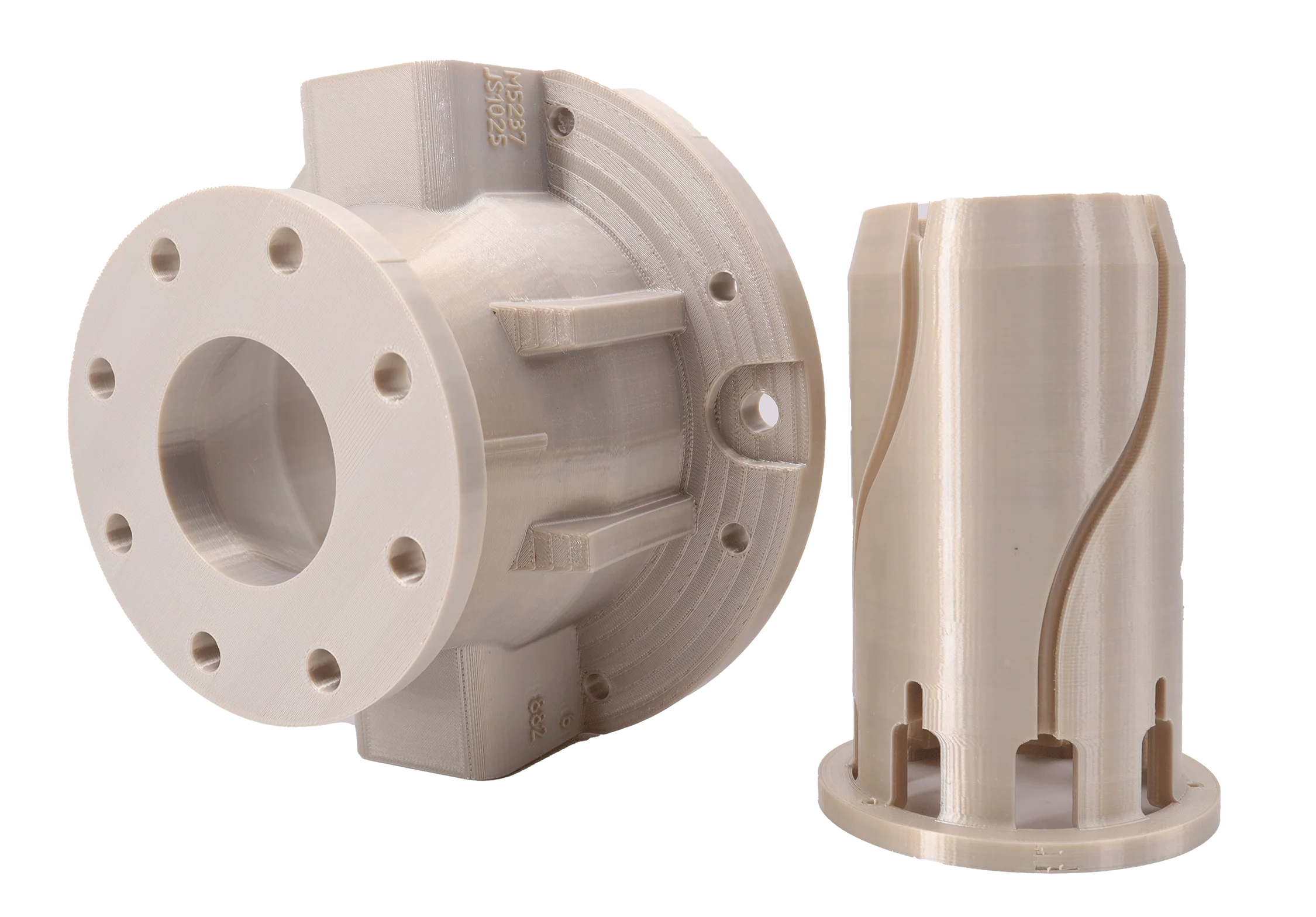
PEEK vs ULTEM™ at a glance
| PEEK | ULTEM™ 9085 | ULTEM™ 1010 | |
|---|---|---|---|
| Polymer type | Semi-crystalline (PAEK) | Amorphous (PEI blend) | Amorphous (PEI) |
| Main strength | Chemical and wear resistance at high temperature | Certified FST performance with good toughness | Highest heat resistance and stiffness of the ULTEM grades |
| Flame retardancy | Inherently flame-retardant | FAA-approved for FST; meets FAR 25.853 and OSU 65/65 | Inherently flame-retardant |
| Chemical resistance | Excellent | Good | Good |
| Ease of printing | Demanding — needs very high temperatures and controlled crystallisation | Easier, very consistent | Demanding, high temperature |
| Typical uses | Oil and gas, chemical processing, wear parts, high-temperature components | Aircraft and drone interiors, ducting, housings | High-temperature tooling, jigs, under-hood and industrial parts |
Properties vary by grade, print settings and post-processing. Always confirm suitability with the material’s technical data sheet — we can share it with your quote.
When to choose PEEK
- Aggressive chemicals. PEEK resists a very wide range of oils, fuels, solvents and chemicals, which is why it is common in oil and gas and chemical-processing parts.
- Wear and friction. Bushings, seals, gears and sliding parts benefit from PEEK’s wear resistance.
- Long-term heat. Its semi-crystalline structure helps PEEK keep useful properties in continuous high-temperature service.
- Replacing metal. PEEK can replace some metal parts where weight or corrosion is a concern.
When to choose ULTEM™
- Aircraft and vehicle interiors. ULTEM™ 9085 is FAA-approved for flame, smoke and toxicity (FST) applications and meets FAR 25.853 and OSU 65/65.
- Hot tooling and fixtures. ULTEM™ 1010 offers the highest heat resistance and stiffness of the ULTEM grades, which suits jigs, fixtures and tools used near heat.
- Strong, consistent prints. ULTEM™ prints more predictably than PEEK, which helps with larger parts and repeat orders.
- Electrical parts. Its inherent flame retardancy and electrical insulation make it a common choice for housings and connectors.
High-performance polymers at Quick 3D
On FDM we print Stratasys ULTEM™ PEI 9085 and 1010, Fiberlogy ULTEM™ PEI 9085, 3DXTech ThermaX™ PEI 9085 and 1010, ThermaX™ PEEK and PEKK A, Stratasys PPSU / PPSF, and FluorX™ PVDF. On SLS we offer PEEK 5100 for support-free, complex parts. See also our guide to heat-resistant 3D printing materials and flame-retardant materials.
Frequently asked questions
Is PEEK better than ULTEM?
Neither is better overall. PEEK leads on chemical and wear resistance. ULTEM™ prints more easily and consistently, and ULTEM™ 9085 is certified for aircraft-interior FST requirements. Choose by the environment your part has to survive.
What is the difference between ULTEM 9085 and ULTEM 1010?
ULTEM™ 9085 is tougher and certified for flame, smoke and toxicity (FST) applications such as aircraft interiors. ULTEM™ 1010 has higher heat resistance and stiffness, so it suits high-temperature tooling and industrial parts.
Is ULTEM the same as PEI?
Yes. ULTEM™ is SABIC’s brand name for polyetherimide (PEI). ULTEM™ 9085 is a PEI blend and ULTEM™ 1010 is an unfilled PEI.
Can PEEK and ULTEM be 3D printed with SLS?
We offer PEEK 5100 on SLS for complex, support-free parts. ULTEM™, PEEK and PEKK are also available on FDM.
Are PEEK and ULTEM flame-retardant?
Both are inherently flame-retardant polymers. ULTEM™ 9085 is the grade with FAA approval for FST applications and FAR 25.853 compliance.
Need a high-performance part?
Tell us the temperature, chemicals and standards your part must meet. We will recommend PEEK, ULTEM™ or another polymer and quote your part.
Get a QuoteWhatsApp UsULTEM™ is a trademark of SABIC. All other product names are trademarks of their respective owners.