Learn · Materials
Metal 3D Printing Materials Compared: Titanium, Stainless Steel, Aluminium, Inconel and More
Metal 3D printing can make lattices, internal cooling channels and lightweight brackets that machining and casting cannot. The right alloy depends on what matters most: weight, corrosion, heat, hardness or conductivity. This guide compares the 11 metals we print.
How metal 3D printing works
Metal 3D printing (DMLS / SLM) uses high-powered lasers to fuse fine metal powder layer by layer under an inert gas atmosphere. The result is a dense, high-strength metal part. Parts are then stress-relieved, cut from the build plate and finished. Learn more about our metal 3D printing service.
Metal 3D printing materials at a glance
| Material | Key strengths | Typical uses |
|---|---|---|
| Titanium Ti64 | Excellent strength-to-weight ratio, corrosion resistant | Aerospace and drone brackets, motorsport parts, medical and lightweight structural parts |
| Aluminium AlSi10Mg | Lightweight, good thermal properties, the most common printed aluminium alloy | Housings, heat exchangers, brackets, lightweight prototypes |
| Aluminium AL6061 | Lightweight; a widely used engineering alloy that engineers already know from machining | Structural parts, fixtures and parts designed around 6061 properties |
| Stainless Steel 316L | Excellent corrosion resistance, ductile and tough | Marine, food-processing, chemical and fluid-handling parts |
| Stainless Steel 17-4 PH | Higher strength and hardness after heat treatment, good corrosion resistance | Tooling, valve and pump parts, wear parts |
| Inconel 718 | Nickel superalloy that keeps high strength at high temperatures | Turbine and engine parts, oil and gas tools, high-temperature brackets |
| Inconel 625 | Outstanding corrosion and oxidation resistance, also handles heat | Chemical processing, marine, exhaust and heat-exchanger parts |
| Cobalt Chrome CoCrMoW | Hard, wear- and corrosion-resistant | Wear parts, dental applications, high-temperature components |
| Maraging Steel 18Ni300 (MS1 / 1.2709) | Very high strength and hardness after ageing | Mould and tooling inserts with conformal cooling, high-strength parts |
| Bronze CuSn10 | Good wear and corrosion resistance | Bushings, bearings, marine parts, decorative and art pieces |
| Pure Copper Cu | The highest electrical and thermal conductivity of the group | Induction coils, heat sinks, heat exchangers, electrical components |
Cobalt chrome is printed as CoCrMoW (SP2). Exact properties depend on the grade, build orientation and heat treatment — we share full technical and safety data sheets for every material.
Choosing by requirement
Lightweight and strong
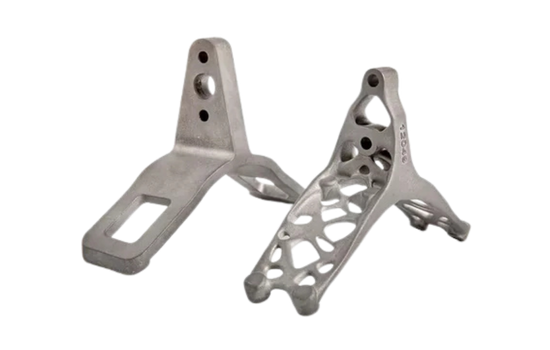
Titanium Ti64 gives the best strength for its weight and resists corrosion, which makes it the first choice for flight hardware and high-performance brackets. Aluminium AlSi10Mg is lighter still and lower in cost, and its thermal properties suit housings and heat exchangers.
Corrosion resistance
316L stainless steel is a dependable all-rounder for wet, marine and food-processing environments. For harsher chemicals or high temperatures, Inconel 625 offers even greater corrosion and oxidation resistance.
Heat
The nickel superalloys Inconel 718 and Inconel 625 keep their strength where steels and aluminium soften, which is why they are used in turbine, exhaust and oil and gas parts.
Hardness and wear
Maraging steel and 17-4 PH stainless reach high strength and hardness after heat treatment, making them a good match for tooling and mould inserts. Cobalt chrome and bronze are chosen for wear resistance.
Conductivity
Pure copper conducts heat and electricity far better than the other alloys, so it suits induction coils, heat sinks and electrical parts with complex shapes.
Post-processing matters
Raw metal prints need finishing to reach their final properties and tolerances. Our post-processing includes vacuum thermal annealing for stress relief, EDM wire-cutting to separate parts from the build plate, multi-axis CNC machining for tight-tolerance interfaces, and media blasting or chemical polishing for the surface finish.
When to choose metal 3D printing
Choose metal 3D printing for geometries that machining and casting cannot make — lightweight lattice structures, internal cooling channels and topology-optimised parts. For simple blocks and flat parts, CNC machining is usually cheaper. Compare the two in 3D printing vs CNC machining.
Frequently asked questions
What is the strongest metal for 3D printing?
For outright strength and hardness, maraging steel and 17-4 PH stainless steel after heat treatment, and Inconel 718, are among the strongest. For strength relative to weight, titanium Ti64 is usually the best choice.
What is the lightest metal you can 3D print?
Aluminium. We print aluminium AlSi10Mg and AL6061. Titanium Ti64 is heavier than aluminium but much stronger, so it often gives a lighter part for the same strength.
Which metal is best for corrosion resistance?
316L stainless steel is a dependable choice for most wet and marine environments. Inconel 625 offers even higher corrosion and oxidation resistance for harsh chemicals and high temperatures.
Which metals does Quick 3D 3D print?
Titanium Ti64, stainless steel 316L and 17-4 PH, aluminium AlSi10Mg and AL6061, Inconel 718 and 625, cobalt chrome CoCrMoW, maraging steel 18Ni300, bronze CuSn10 and pure copper.
How long does metal 3D printing take?
Metal parts can be ready in as little as 7 days, depending on part size, quantity and post-processing.
Need help choosing an alloy?
Tell us what your part has to withstand. We will recommend a metal, share its data sheet and quote your part.
Get a QuoteWhatsApp Us