
Learn · Industry Applications
3D Printing for Electronics Manufacturing: ESD Fixtures, Trays and Test Jigs
Electronics lines need tooling that is accurate, fast to make and safe around static-sensitive components. Here is how ESD-safe 3D printing delivers jigs, fixtures, trays and test nests in days — and how to choose the right material.
Why electronics lines 3D print their tooling
Electronics manufacturing changes fast. New boards, new revisions and new test steps all need new jigs, nests and trays — and every one of them must be safe around static-sensitive components. Machining that tooling takes time and money; 3D printing it in static-dissipative materials gets it onto the line in days.
- Speed: FDM fixtures can be ready in as little as 1 day, so tooling keeps pace with board revisions.
- Shaped to the board: a printed nest follows the exact outline of your PCB or module, so it locates accurately and protects components.
- Static-safe: ESD-safe materials dissipate charge slowly instead of letting it build up and discharge into components.
- Easy to iterate: change the CAD, print again — no new machining set-up.
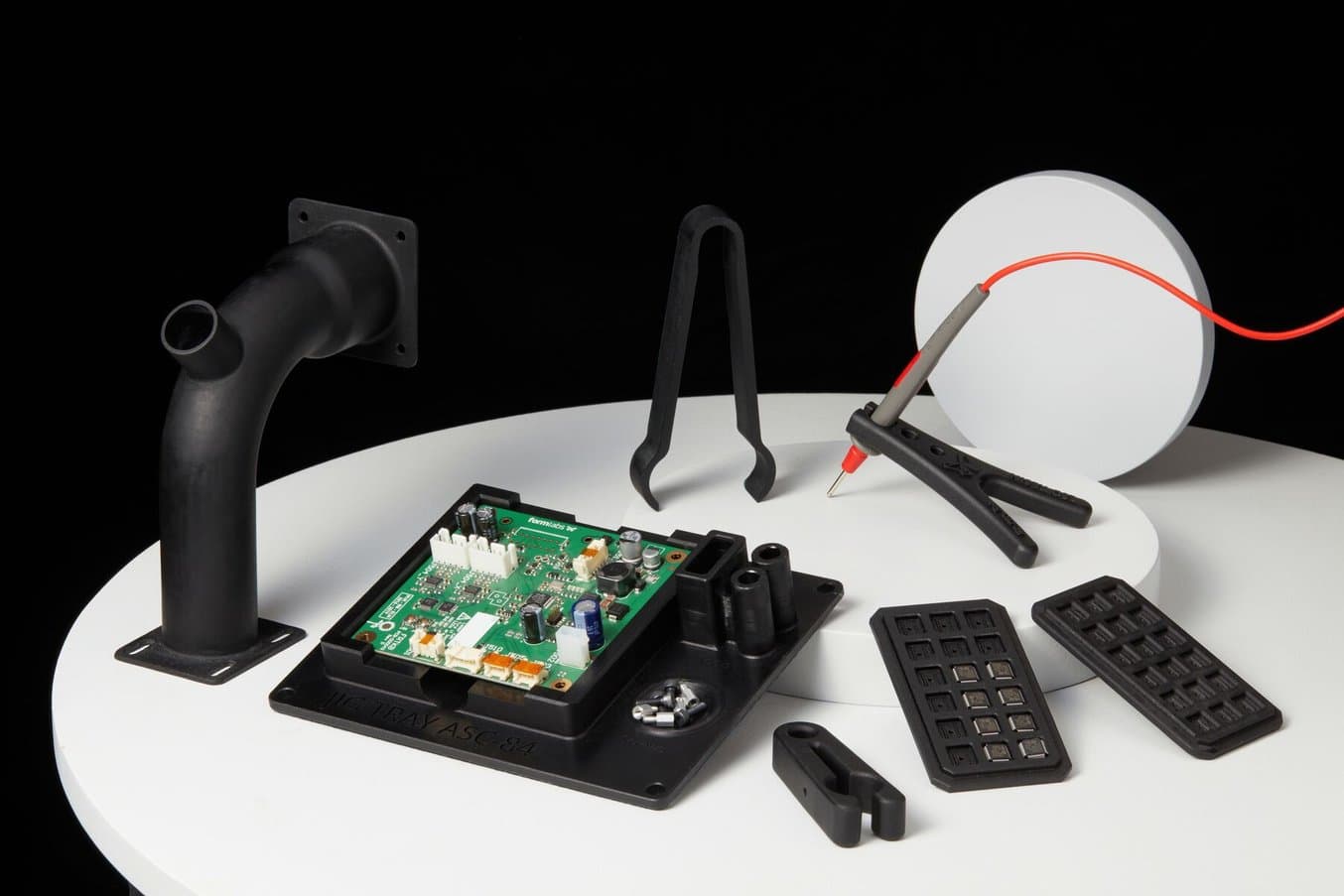
What you can make
| Tooling | What it does |
|---|---|
| Assembly jigs and nests | Locate boards and components during assembly, soldering and rework. |
| Test and inspection fixtures | Hold boards and modules in a repeatable position for testing, inspection and CMM measurement. |
| Trays and carriers | Store and move components between process steps without static risk. |
| End-of-arm tooling | Lightweight grippers and fingers for pick-and-place and automation cells. |
| Enclosures and covers | Anti-static housings for control panels, test equipment and electronic systems. |
| Brackets and sensor mounts | Adapt and maintain production equipment quickly. |
Choosing an ESD-safe material
At Quick 3D you can choose static-dissipative materials on two processes. Each comes with technical and safety data sheets, so you can confirm properties for your line.
| Material | Process | Good for |
|---|---|---|
| ABS-ESD7 | FDM | General-purpose fixtures, trays and covers. |
| PETG-ESD | FDM | Tough fixtures and trays that need good impact resistance. |
| PA612-ESD | FDM | Nylon toughness for fixtures that see more wear and handling. |
| ESD Resin | SLA | Small, detailed nests and fixtures; stiffness and impact strength similar to ABS. |
Not sure which to pick? Read What is ESD-safe 3D printing? or see all ESD-safe materials.
Design tips for electronics fixtures
- Design to the process accuracy. Quick 3D’s prototyping and industrial FDM services achieve ±0.3 mm, so leave sensible clearance around board edges and components.
- Relieve tall components. Pocket around connectors, capacitors and test points so the board sits on its edges or defined datum points.
- Add wear inserts where needed. Use metal bushings or threaded inserts for pins, clamps and screws that are used thousands of times.
- Make orientation obvious. Add a chamfer, notch or embossed label so operators cannot load a board the wrong way.
- Keep walls sensible. See our wall thickness guide for printable, stiff sections.
From board to fixture: the workflow
- Send your data — board outline, CAD, drawing or a sample part.
- Design — our design team can create the fixture around your board.
- Print — in the ESD-safe material that suits the job.
- Inspect and deliver — every order is dimensionally and visually inspected.
For more tooling ideas, read 3D printed jigs and fixtures or visit our electronics manufacturing page.
Frequently asked questions
What is an ESD-safe 3D printed fixture?
It is a fixture printed in a static-dissipative material, which lets charge drain away slowly instead of building up and discharging into sensitive components.
Which ESD-safe materials does Quick 3D offer?
ABS-ESD7, PETG-ESD and PA612-ESD on FDM, and ESD Resin on SLA for small, detailed parts.
How quickly can I get ESD-safe fixtures?
FDM parts can be ready in as little as 1 day and SLA parts in 3 days, depending on size and quantity.
Can you design the fixture from my PCB?
Yes. Send a board outline, CAD file, drawing or sample and our design team can create the fixture and prepare it for printing.
Need ESD-safe tooling?
Share your board outline, CAD file or a sample. We’ll recommend the right ESD-safe material — or design the fixture for you.
Get a QuoteWhatsApp Us