
Learn · Glossary
What Is DfAM (Design for Additive Manufacturing)?
Why DfAM matters
Most parts are designed for traditional manufacturing — machining, moulding or casting — and their shapes reflect those processes’ limits. Printing such a part “as is” works, but leaves most of 3D printing’s benefits unused. DfAM rethinks the design so the part takes full advantage of the process.
The core principles of DfAM
1. Part consolidation
Several parts that were bolted, welded or glued together can often be printed as one. Fewer parts means fewer assembly steps, fewer joints to fail and less inventory.
2. Lightweighting
Material is placed only where it’s needed. Topology optimisation software removes material that carries little load, decreasing weight while meeting structural requirements. Less material also means lower cost and shorter print times.
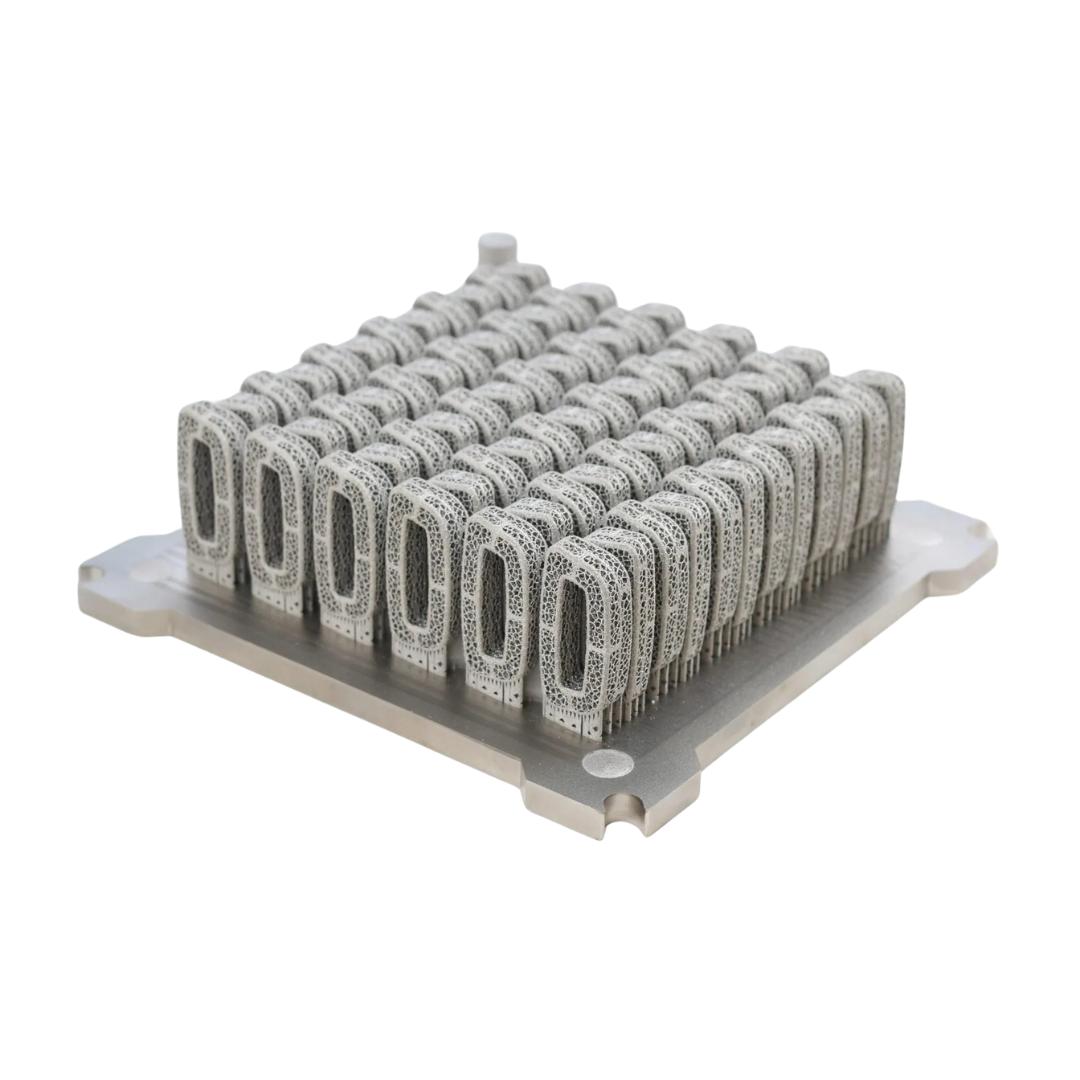
3. Lattices and internal structures
Lattices replace solid volumes with repeating cell structures — for stiffness with low weight, energy absorption, cushioning or flexible zones. Internal channels can route air or fluid in ways machining can’t.
4. Designing for the process
Each process has its own rules. DfAM accounts for minimum wall thickness, overhangs and supports (FDM, SLA and metal), powder removal (SLS and MJF), resin drainage (SLA) and anisotropy — the way FDM parts are weaker between layers.
5. Orientation
How a part sits in the printer affects strength, surface finish, supports, accuracy and cost. Good DfAM chooses the orientation early and designs around it — for example, laying snap-fit beams flat in FDM.
6. Functional integration
Printed parts can include features that would otherwise be separate: living hinges, snap-fits, labels, cable routing, threads for inserts and conformal shapes that fit perfectly around other parts.
What DfAM can achieve
| Goal | DfAM approach |
|---|---|
| Lower weight | Topology optimisation, lattices, hollowing |
| Lower cost | Less material, fewer supports, smarter orientation, nesting more parts per build |
| Fewer parts | Consolidating assemblies into single printed parts |
| Better performance | Internal channels, conformal shapes, tuned stiffness |
| Faster assembly | Snap-fits, integrated features, self-locating parts |
DfAM at Quick 3D
Our design team can optimise your part for additive manufacturing — helping reduce weight, consolidate parts and prepare your 3D data for immediate production — with topology optimisation and tooling design available. See our 3D design services.
Frequently asked questions
What does DfAM stand for?
DfAM stands for design for additive manufacturing — designing parts specifically to take advantage of 3D printing.
What is the difference between DfM and DfAM?
DfM (design for manufacturing) usually refers to traditional processes such as machining and moulding. DfAM applies the same idea to 3D printing, where the rules and opportunities are different — such as lattices, part consolidation and no tooling.
Does DfAM reduce cost?
Often, yes. Using less material, reducing supports, choosing a good orientation and consolidating parts all lower the cost of a 3D printed part.
What is topology optimisation?
Topology optimisation is a software method that removes material where it carries little load, producing a lighter part that still meets its structural requirements.
Want to get more from 3D printing?
Send us your part. Our design team will suggest how DfAM can make it lighter, stronger or cheaper.
Get a QuoteWhatsApp Us