
Learn · Materials
Heat-Resistant 3D Printing Materials: How to Choose the Right One
A part that’s perfect at room temperature can sag, warp or lose its strength next to an engine, inside a machine or under a hot sheet of plastic. Here’s how to pick a 3D printing material that keeps its shape when the temperature climbs.
First, understand the heat ratings
Datasheets describe heat performance in several ways. Knowing which one matters for your part avoids nasty surprises:
- Heat deflection temperature (HDT) — the temperature at which a standard test bar bends by a set amount under a set load. It is the most common number for comparing materials. HDT is quoted at different loads (commonly 0.45 MPa and 1.8 MPa), so make sure you compare like with like.
- Glass transition temperature (Tg) — the point where an amorphous plastic changes from rigid to rubbery. Above Tg, stiffness drops sharply.
- Continuous use temperature — how hot a material can run for long periods without degrading. This is often lower than HDT, and it is the better guide for parts that stay hot all day.
Heat-resistant materials, from good to extreme
| Tier | Materials we offer | Good for | Watch out for |
|---|---|---|---|
| Engineering plastics | ABS, ASA, PC, PC-ABS (FDM); PA11, PA12 (SLS, MJF) | Housings, brackets and fixtures that get warm but not hot; ASA also handles outdoor sun | Not for sustained high temperatures |
| Reinforced nylons | Glass- and carbon-filled PA6 and PA12, PA612-CF (FDM, SLS) | Stiff parts that must hold shape under heat and load, such as under-bonnet brackets and tooling | Fillers raise stiffness and heat resistance but reduce flexibility |
| High-temperature resin | High Temp resin (SLA) | Very high HDT with fine detail: hot air and fluid flow tests, heat-resistant moulds and fixtures | Brittle — avoid impact or bending loads |
| High-performance polymers | PPS composites, PPSU/PPSF, ULTEM™ PEI 9085 and 1010, PEKK, PEEK (FDM); PEEK 5100 (SLS) | Parts that run hot continuously and face chemicals, fuels or demanding certifications | Higher material and machine cost; specialist printers needed |
| Metal | Metal 3D printing | Temperatures beyond any polymer, and the highest strength | Highest cost; more post-processing |
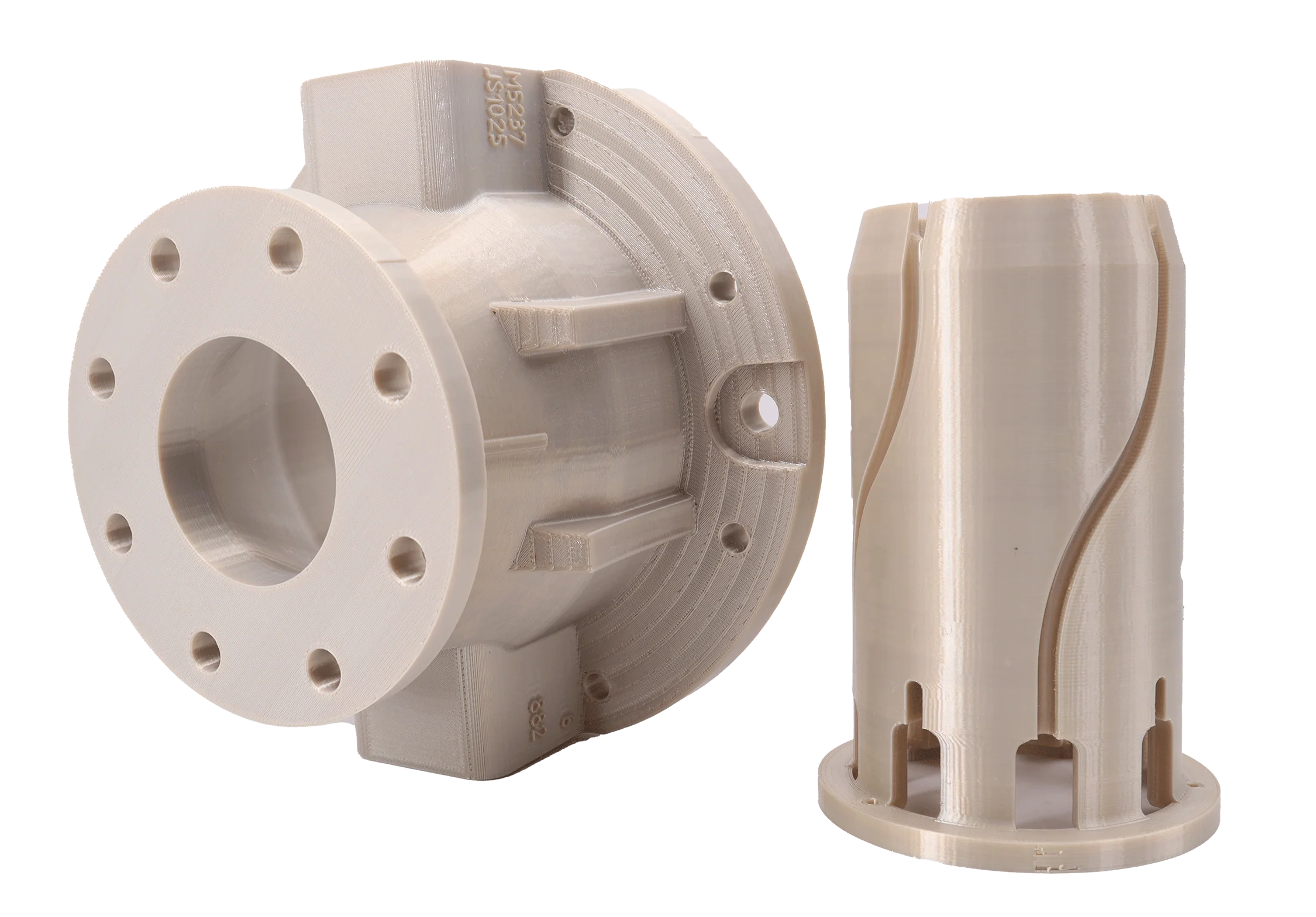
A closer look at the high-performance polymers
ULTEM™ PEI 9085 and 1010
PEI (polyetherimide) combines strength, heat resistance and inherent flame retardancy. ULTEM™ 9085 is FAA-approved for FST applications and meets FAR 25.853 and OSU 65/65 standards, which is why it is widely used for aircraft interior parts. ULTEM™ 1010 offers even higher heat resistance and is often chosen for demanding tooling. See our aerospace-grade materials.
PEEK and PEKK
These PAEK-family polymers sit at the top of the polymer range for heat, chemical and wear resistance. They are used for parts near engines, in oil and gas equipment and in harsh chemical environments — often as a lightweight replacement for metal.
PPS and PPSU/PPSF
PPS is known for excellent chemical resistance at elevated temperatures; reinforced with glass or carbon fibre it becomes stiff and dimensionally stable. PPSU/PPSF is a tough high-temperature plastic often chosen for parts that must withstand repeated heat exposure.

How to choose: four questions
- How hot, and for how long? A brief spike (a hot-wash cycle) is very different from running hot all day. For continuous heat, look at continuous use temperature, not just HDT.
- What load is the part under while hot? A loaded bracket softens and creeps sooner than an unloaded cover. Compare HDT values at the load that matches your use.
- What else is it exposed to? Fuels, oils, cleaning chemicals, steam or UV can rule materials out — or in.
- Does it need a certification? Flame retardancy, FST, food contact or other approvals narrow the list quickly.
Common heat-resistant applications
- Automotive under-bonnet brackets, ducts and covers — see automotive 3D printing.
- Moulds and tooling for thermoforming, composite layups and casting — see thermoforming with 3D printed moulds.
- Fixtures and jigs used near ovens, heaters or hot processes.
- Aerospace and drone parts that must meet flame and FST requirements.
- Oil and gas parts exposed to heat and chemicals — see oil & gas 3D printing.
- Hot air and fluid testing of prototypes before production.
How Quick 3D can help
Our FDM library includes high-performance polymers such as ULTEM™ PEI 9085 and 1010, PEEK, PEKK and PVDF, plus carbon- and glass-filled nylon, PET and PPS composites. We also offer PEEK 5100 on SLS and High Temp resin on SLA. Tell us the temperature, load and environment, and we’ll recommend the most economical material that will do the job.
*The ULTEM™ and 9085 trademarks are used under license from SABIC, its affiliates or subsidiaries.
Frequently asked questions
What is the most heat-resistant 3D printing material?
Among polymers, the PAEK family (PEEK and PEKK) and PEI (ULTEM™) sit at the top for heat resistance. For temperatures beyond what any polymer can handle, metal 3D printing is the answer.
What does HDT mean?
HDT (heat deflection temperature) is the temperature at which a standard test bar bends by a set amount under a set load. It is useful for comparing materials, but always compare values measured at the same load.
Is heat-resistant the same as flame-retardant?
No. Heat resistance is about keeping shape and strength when hot. Flame retardancy is about resisting burning and self-extinguishing, rated for example to UL94 V-0. Some materials, such as ULTEM™ 9085, offer both.
Can I use a 3D printed part near an engine?
Often, yes — with the right material. Reinforced nylons and high-performance polymers such as PEI, PEKK and PEEK are used for under-bonnet parts. Share the operating temperature, load and any fluids it will touch so we can recommend a suitable grade.
Need a part that can take the heat?
Tell us the temperature, load and environment. We’ll recommend the right heat-resistant material and process.
Get a QuoteWhatsApp Us