
3D printing for industrial equipment — manufacture better, whatever you make.
Bring the convenience of digital parts to your factory. With Quick 3D, process inefficiencies and logistical headaches become competitive advantages — from custom tooling to spare parts on demand.
What we make for equipment makers
Jigs & fixtures
Custom holding, alignment and inspection fixtures that are faster and cheaper to make than machined tools.
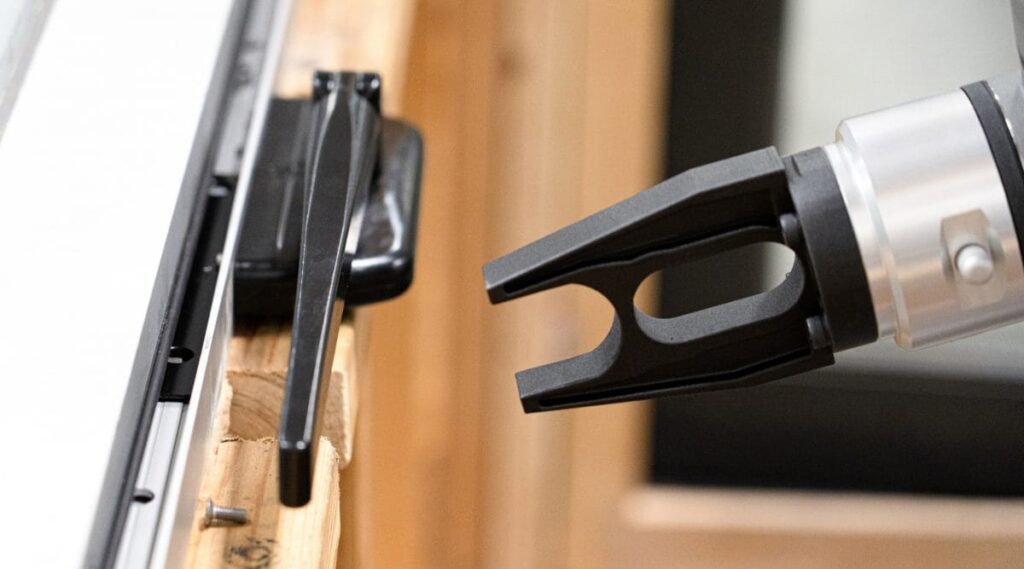
End-of-arm tooling
Lightweight robot grippers and custom fingers in carbon-fibre composites.
Spare parts on demand
Reduce downtime by printing replacement parts when you need them, from CAD files or 3D scans. Spare parts service →
Enclosures & housings
Rugged covers, guards and housings in durable nylon by MJF or SLS.
Low-volume production parts
Functional end-use parts without the cost of injection-moulding tools.
ESD-safe parts
Static-dissipative trays, fixtures and tools for electronics assembly lines. Electronics manufacturing →
Recommended processes
FDM
Carbon-fibre composites and engineering plastics for fixtures, grippers and tooling.
Low-Volume Production
Low- to mid-volume production with consistent quality control.
Why engineering teams choose Quick 3D
500+ industrial materials
From carbon-fibre composites and ESD-safe plastics to FAA-approved polymers and metal alloys — with full TDS and SDS documentation.
Fast lead times
FDM parts in as little as 1 day, SLA in 3 days, and SLS, MJF, PolyJet and metal in as little as 7 days.
Inspected and protected
Every order is dimensionally and visually inspected, and we sign NDAs to protect your designs.
Frequently asked questions
What industrial equipment parts can be 3D printed?
Common applications include jigs and fixtures, end-of-arm robot tooling, gauges, enclosures and guards, brackets, spare and replacement parts, and low-volume production parts.
Which materials are best for jigs and fixtures?
Carbon-fibre reinforced nylon and continuous carbon-fibre composites are popular for stiff, lightweight fixtures. ESD-safe grades suit electronics assembly, and PEEK or ULTEM PEI suit high-temperature environments.
Can I keep spare parts as digital files instead of stock?
Yes. We store your part files securely and print replacements on demand, so you do not need to hold physical inventory.
Should I use MJF or SLS for production parts?
Both make strong, support-free nylon parts. MJF suits high-throughput batches with consistent, isotropic strength, while SLS offers a wider material range including PEEK, glass- and carbon-filled nylon and PP.
How fast can you make a fixture or spare part?
FDM fixtures and spare parts can be ready in as little as 1 day; SLS, MJF and metal parts in as little as 7 days.
Start your project
Share your CAD file, drawing or a sample part. Our engineers will recommend the right process, material and cost. Guide: 3D printed robot grippers →