
Learn · Industry Applications
3D Printed End-of-Arm Tooling (Robot Grippers): A Practical Guide
Custom grippers and fingers are what let a robot handle your parts. Here is why factories 3D print end-of-arm tooling, which materials to use, and how to design grippers that last.
What is end-of-arm tooling?
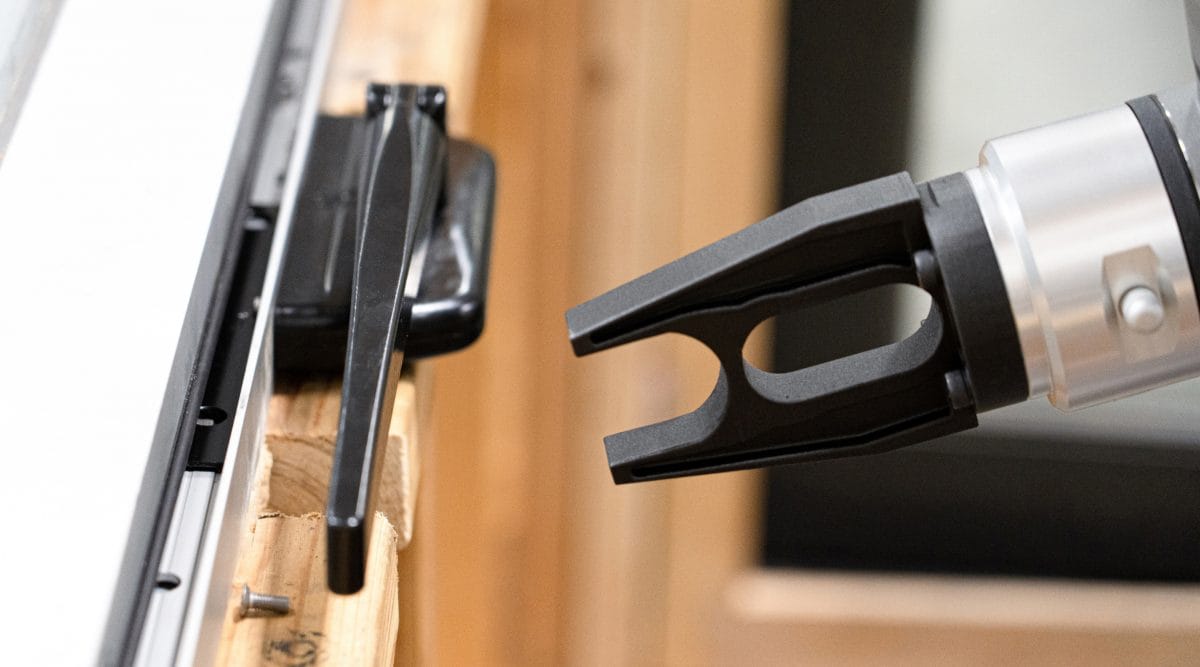
End-of-arm tooling (EOAT) is whatever sits on the end of a robot or cobot arm to do the work — grippers, custom fingers, vacuum cups and manifolds, and the brackets that hold sensors and cameras. Off-the-shelf grippers handle standard shapes; custom fingers and adaptors are what make a robot handle your parts.
Why 3D print EOAT?
- Lighter tooling: printed grippers weigh far less than machined aluminium or steel. Less tool weight leaves more of the robot’s payload for the part, and reduces inertia on fast moves.
- Shaped to the part: fingers can follow the exact contour of your product, holding it securely without marking it.
- Fewer parts: brackets, fingers and mounts can be combined into one printed piece.
- Internal channels: powder-bed processes can build air or vacuum channels inside the part, with no extra tubing.
- Fast changeovers: when the product changes, print new fingers — FDM parts can be ready in as little as 1 day.
Choosing a process and material
| Process | Materials | Best for |
|---|---|---|
| FDM | Carbon-fibre nylon and continuous carbon-fibre composites | Stiff, lightweight grippers, fingers and brackets |
| MJF / SLS | PA12, PA11, glass- or carbon-filled nylon | Complex grippers with internal vacuum or air channels; repeatable batches |
| TPU (SLS, MJF) | Flexible TPU | Soft pads, compliant fingers and grip surfaces |
| FDM (ESD-safe) | ABS-ESD7, PETG-ESD, PA612-ESD | Grippers that handle static-sensitive electronics |
| Metal | Stainless steel, aluminium AlSi10Mg, titanium Ti64 | High-load or high-wear tooling |
Comparing nylons? Read PA11 vs PA12 nylon. Working with electronics? See ESD fixtures for electronics manufacturing.
Design tips for robot grippers
- Start from the payload budget. Subtract the tool weight from the robot’s rated payload — every gram saved can go to the part or to speed.
- Add fillets at the root of fingers. Sharp corners concentrate stress where fingers meet the base.
- Use inserts for mounting. Threaded inserts or metal bushings keep bolted interfaces strong over thousands of cycles.
- Design for the grip. Contoured nests or soft TPU pads hold parts more securely than flat jaws.
- Hollow and rib. Remove material that does not carry load — see design for additive manufacturing.
- Check clearances. Quick 3D’s prototyping and industrial FDM services achieve ±0.3 mm, so allow for that in mating features.
How Quick 3D can help
Send us your part CAD, the robot or gripper model, and how the part is picked and placed. Our design team can design the fingers or the full tool, and we print it in the right material. See 3D printing for industrial equipment and 3D printed jigs and fixtures.
Frequently asked questions
What is end-of-arm tooling (EOAT)?
End-of-arm tooling is the device on the end of a robot arm that does the work — grippers, custom fingers, vacuum cups and manifolds, and sensor brackets.
Are 3D printed robot grippers strong enough?
For many applications, yes. Carbon-fibre composites and engineering nylons give stiff, lightweight tooling, with inserts at bolted joints. For very high loads or wear, metal printing may be better.
Why use 3D printing instead of machining for grippers?
Printed grippers are lighter, can follow the part’s exact shape, combine several parts into one and include internal air channels — and new versions can be made quickly when products change.
Can you design the gripper for me?
Yes. Send your part CAD, the robot or gripper model and how the part is handled, and our design team can design the fingers or the full tool.
Need custom grippers?
Share your part CAD and robot details. We’ll recommend the material and process — or design the tooling for you.
Get a QuoteWhatsApp Us