
Learn · Glossary
What Is MJF (Multi Jet Fusion) 3D Printing?
How MJF works
- Spread powder. A thin layer of nylon powder is spread across the build area.
- Jet the agents. Print heads apply a fusing agent where the part should be solid, and a detailing agent around the edges for crisp, accurate surfaces.
- Fuse with heat. Heating elements pass over the bed, fusing the treated powder into a solid layer.
- Repeat and cool. Layer by layer the parts grow inside the powder, then the build cools before parts are removed.
- Clean and finish. Loose powder is removed and parts are media blasted; they can also be vapour-smoothed or dyed.
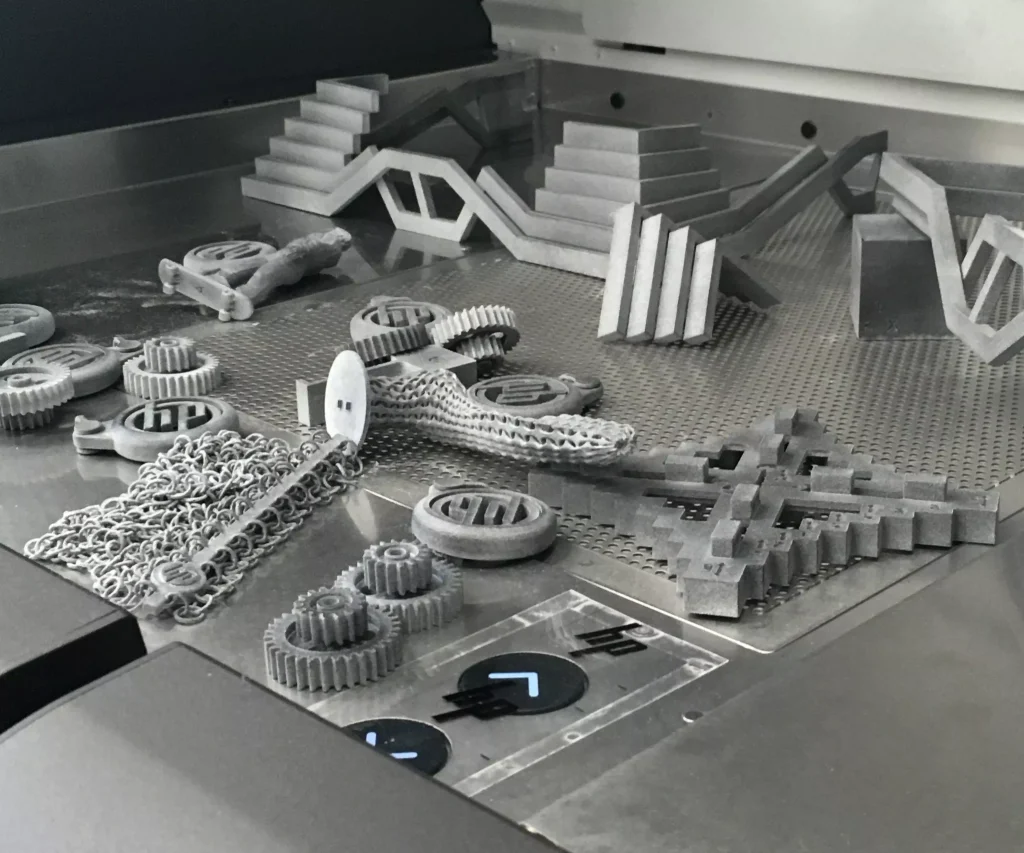
The surrounding powder supports the parts as they print, so no support structures are needed and parts can be nested together to fill the build.
MJF materials
| Material | Good for |
|---|---|
| HP PA12 | Strong, low-cost parts — the general-purpose choice |
| HP PA11 | Ductile, bio-based parts for repeatable production; snap-fits and impact-prone parts |
| HP PA12 Glass Beads | Stiff, dimensionally stable parts |
| HP TPU | Flexible parts, from prototypes to production |
| HP Nylon Full Colour | Full-colour nylon parts for realistic prototypes and models |
Not sure between the two main nylons? Read PA11 vs PA12.
What MJF is best for
- Rugged enclosures and housings
- Complex brackets and interlocking assemblies
- Rapid batch production, bridging the gap between prototyping and full-scale manufacturing without expensive tooling
- Functional parts that need consistent strength in every direction — such as snap-fits
MJF vs SLS
Both are support-free powder-bed processes for nylon parts. MJF focuses on high-throughput production with fine detail and consistent, isotropic strength across batches. SLS offers a wider material range, including PEEK, glass- and carbon-filled nylons, PP and castable PS. For a wider comparison, see FDM vs SLA vs SLS vs MJF.
MJF at Quick 3D
MJF parts can be ready in as little as 7 days. Finishing options include media blasting, chemical vapour smoothing and deep-dye black. See our MJF 3D printing service.
Frequently asked questions
What does MJF stand for?
MJF stands for Multi Jet Fusion, a 3D printing technology developed by HP.
Does MJF need support structures?
No. The unfused powder supports the parts during printing, so MJF parts need no support structures.
What colour are MJF parts?
Standard MJF nylon parts come out grey and are commonly dyed black. HP Nylon Full Colour can produce full-colour parts.
Is MJF strong enough for end-use parts?
Yes. MJF produces dense parts with uniform mechanical properties in every direction and is widely used for functional and low-volume production parts.
Is MJF right for your part?
Send us your file. We’ll recommend MJF, SLS or another process — and the right material.
Get a QuoteWhatsApp Us