
Learn · Decision Guides
3D Printing vs CNC Machining: Which Should You Choose?
Both can turn a CAD file into a precise, functional part. But one builds material up and the other cuts it away — and that single difference decides which is faster, cheaper and better for your design.
How they work
- 3D printing (additive manufacturing) builds a part layer by layer, adding material only where it’s needed. Processes include FDM, SLA, SLS, MJF, PolyJet and metal.
- CNC machining (subtractive manufacturing) starts with a solid block of material and cuts it away with rotating tools until only the part is left.
Side-by-side comparison
| 3D printing | CNC machining | |
|---|---|---|
| Geometry | Very high freedom: internal channels, lattices, organic shapes and consolidated assemblies | Limited by tool access: deep internal features and undercuts are difficult or impossible |
| Accuracy & surface | Good; varies by process. Layer lines on some processes. (Our FDM: ±0.3 mm.) | Typically tighter tolerances and smoother machined surfaces |
| Materials | Over 500 materials: plastics, composites, resins, elastomers and metals | Wide range of metals and plastics in solid stock form |
| Set-up | Minimal — no fixtures or tool paths per part | Programming, fixturing and tool changes for each part |
| Complexity cost | Complex shapes cost little more than simple ones | More features and set-ups mean more cost |
| Material waste | Low — material is added only where needed | Higher — removed material becomes chips |
| Best quantity | One-offs to small and medium batches | One-offs to medium batches; simple parts in larger runs |
| Lead time | FDM from 1 day, SLA from 3 days, SLS/MJF/PolyJet/metal from 7 days | Depends on programming, set-up and machine availability |
Choose 3D printing when…
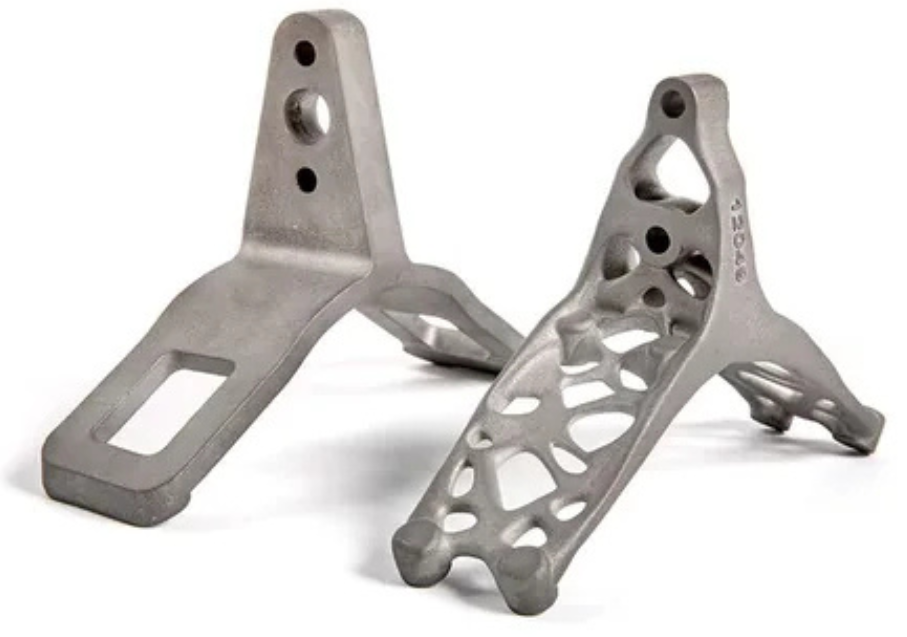
- The part has complex geometry — internal channels, lattices, organic forms or several parts combined into one.
- You need prototypes fast and expect to change the design.
- You need one-offs or small batches without paying for programming and set-up.
- You want lightweight parts through topology optimisation or lattices.
- You need materials machining can’t easily handle, such as flexible elastomers, continuous carbon-fibre composites or full-colour parts.
Choose CNC machining when…
- The part needs very tight tolerances or a fine machined finish on many features.
- The geometry is simple and blocky — plates, shafts and prismatic parts machine efficiently.
- You need a specific metal or plastic grade from solid stock with fully known properties.
- You need larger quantities of a simple part, where set-up cost is spread across many units.
The best of both: print, then machine
You don’t always have to choose. A common approach is to 3D print a part close to its final shape, then machine only the features that need precision — such as bearing bores, sealing faces or threaded holes. For metal parts, we offer multi-axis CNC machining for tight-tolerance interfaces as a post-processing step. For plastic parts, small holes can be drilled or reamed to size, and threads tapped or fitted with inserts.
- Complex shape, few parts, fast changes → 3D printing
- Simple shape, tight tolerances everywhere → CNC machining
- Complex shape and a few precise features → print, then machine
How Quick 3D can help
Send us your CAD file and requirements. Our engineers will recommend the process, material and finishing that suit your part. Read more about what affects 3D printing cost or compare the main 3D printing technologies.
Frequently asked questions
Is 3D printing cheaper than CNC machining?
For complex parts, prototypes and small quantities, 3D printing is often cheaper because there is no programming or fixturing and complexity costs little extra. For simple shapes or larger quantities of machinable parts, CNC can be more economical.
Is CNC machining more accurate than 3D printing?
Generally, yes. CNC machining typically achieves tighter tolerances and smoother surfaces. 3D printing accuracy depends on the process — for example, our FDM services achieve ±0.3 mm — and critical features can be machined after printing.
Can 3D printed metal parts be machined?
Yes. Metal 3D printed parts are often machined on critical interfaces. We offer multi-axis CNC machining for tight-tolerance interfaces as a post-processing step for metal parts.
Which is faster, 3D printing or CNC?
For prototypes and complex parts, 3D printing is usually faster because there is little set-up: FDM parts can be ready in as little as 1 day. Lead times depend on part size, quantity and finishing.
Not sure which process fits your part?
Send us your CAD file, quantity and requirements. We’ll recommend the right process, material and finish.
Get a QuoteWhatsApp Us