
Learn · Industry Applications
3D Printed Jigs and Fixtures: A Guide for Malaysian Factories
Every production line runs on tooling — the jigs, fixtures, gauges and grippers that hold, align and check parts. Machining that tooling is slow and costly. 3D printing it is one of the fastest ways to cut lead times on the factory floor.
Jigs vs fixtures: what’s the difference?
The terms are often used together, but they do slightly different jobs:
- A jig guides a tool — for example, a drill guide that puts every hole in exactly the same place.
- A fixture holds and locates a part while work is done on it — for assembly, machining, gluing, testing or inspection.
Related tooling includes gauges (go/no-go and check gauges), nests and trays that hold parts between stations, and end-of-arm tooling — the grippers and fingers on robots.
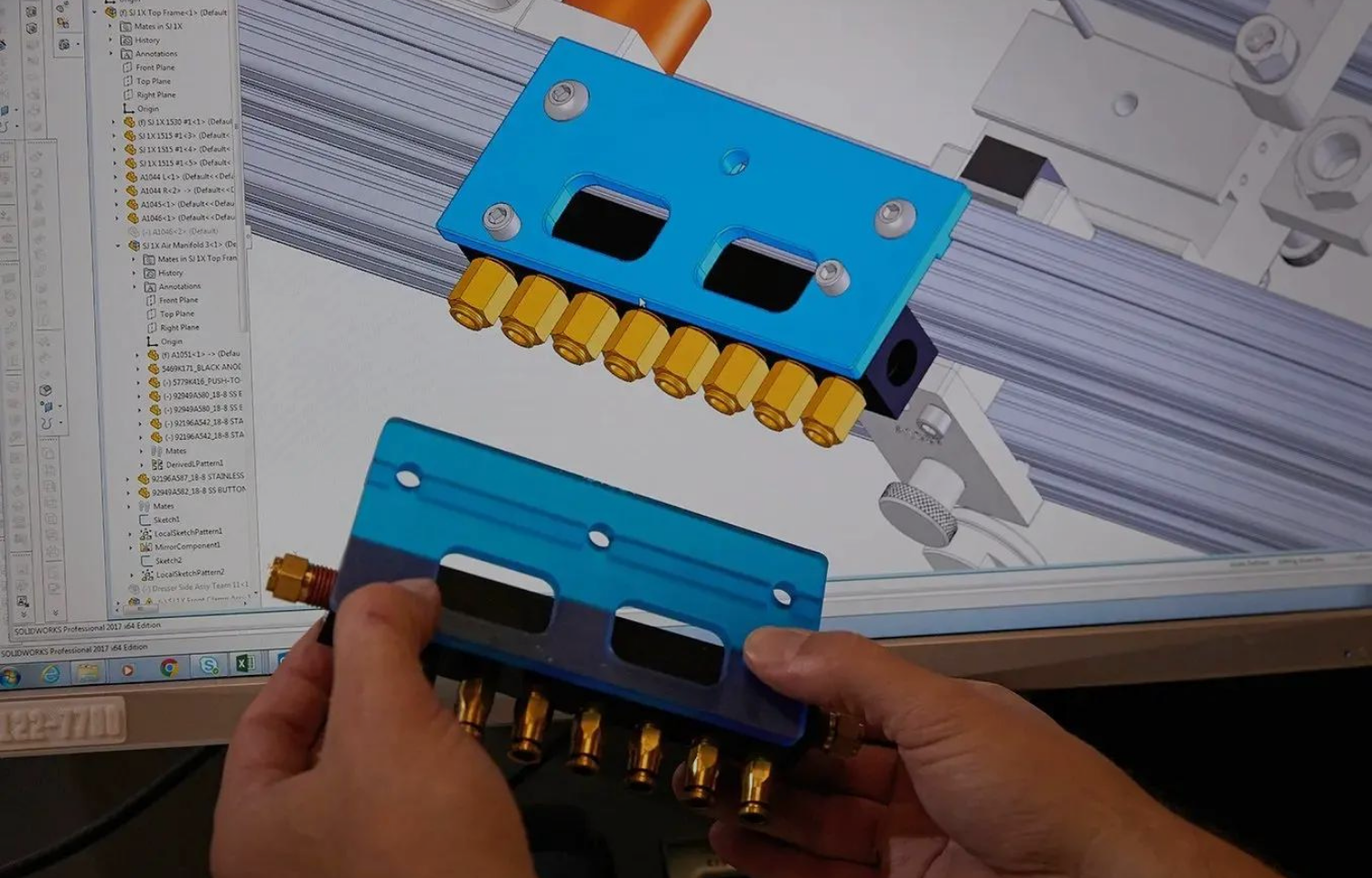
Why 3D print your tooling?
- Faster: custom holding, alignment and inspection fixtures are faster and cheaper to make than machined tools. FDM fixtures can be ready in as little as 1 day.
- Shaped to the part: a printed nest can follow the exact contour of your part, so it locates accurately and avoids scratches.
- Lighter: printed fixtures and grippers weigh far less than metal ones — easier for operators to handle, and less load on robots.
- Easy to change: when the product changes, update the CAD and print a new fixture instead of re-machining.
- Combines parts: several machined and bolted pieces can often become one printed part.
What can you make?
| Tooling | What it does | Good material choices |
|---|---|---|
| Assembly fixtures | Hold and align parts for assembly, gluing or fastening | Carbon-fibre reinforced nylon; ESD-safe grades for electronics |
| Inspection fixtures & gauges | Hold parts in a repeatable position for checking; go/no-go gauges | Stiff, dimensionally stable materials such as carbon-fibre composites or PA12 |
| Drill and cutting guides | Position tools accurately and consistently | Carbon-fibre composites, with metal bushings for wear |
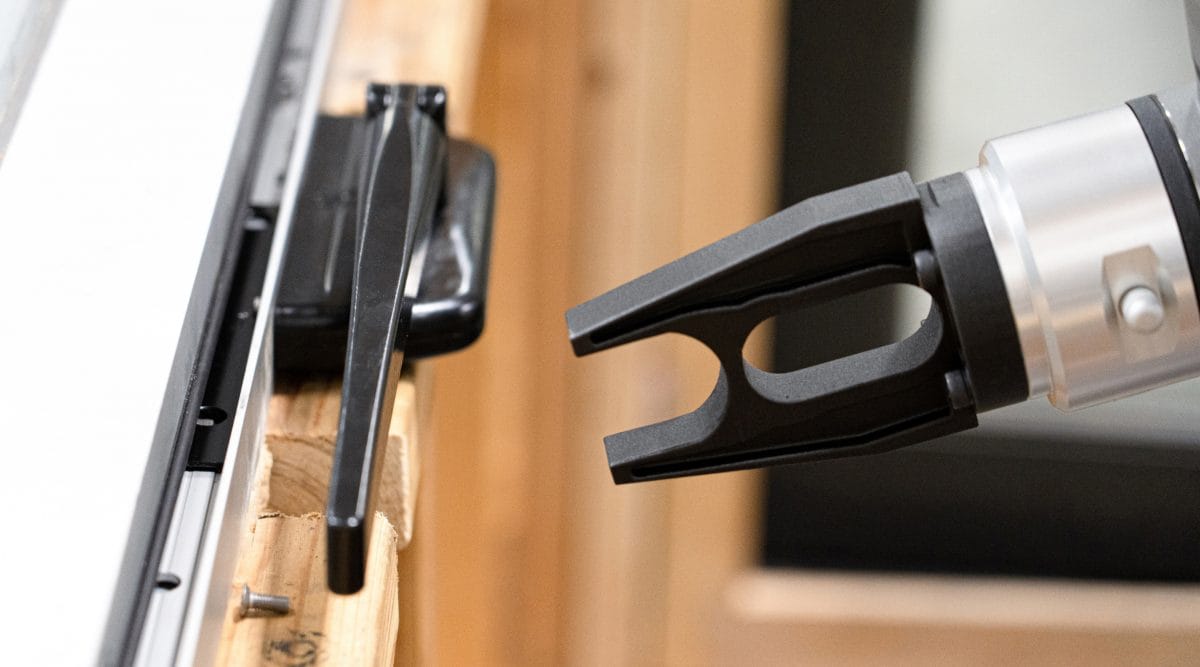
| End-of-arm tooling | Lightweight robot grippers and custom fingers | Carbon-fibre composites |
| Electronics fixtures & trays | Hold boards and components safely during assembly and test | ESD-safe materials |
| Hot-process fixtures | Tooling used near ovens, heaters or hot parts | PEEK or ULTEM™ PEI — see heat-resistant materials |
Which process?
- FDM — the go-to process for fixtures, grippers and tooling, with carbon-fibre composites and engineering plastics. Fast, economical and strong.
- MJF — dense, isotropic PA12 for brackets, nests and tooling made in batches.
- SLS — support-free nylon parts with complex internal features.
- Metal — stainless steel, aluminium and Inconel when tooling needs metal strength.
Design tips for tooling that lasts
- Design around the part. Start from the part’s CAD and subtract it from a block to create an accurate nest, then add clearance.
- Allow for accuracy. Our FDM services achieve ±0.3 mm; leave clearance where parts drop in, and keep tight locating features to just the few points that matter.
- Add metal where it wears. Use threaded inserts for bolts and steel bushings or dowel pins for drill guides and high-wear locators.
- Make it mistake-proof. Add features so a part can only go in one way (poka-yoke).
- Label it. Print part numbers, station names or orientation arrows directly into the fixture.
- Lighten it. Remove material that isn’t doing work — operators will thank you.
How Quick 3D can help
Share your part CAD, a drawing or a sample. We’ll recommend the right material and process — and if you need help designing the tooling, our design team can do it for you. Every order is dimensionally and visually inspected, and we sign NDAs to protect your designs. See our industrial equipment 3D printing page for more applications.
Working in electronics assembly? See 3D printing for electronics manufacturing for ESD-safe fixtures and trays. Need a replacement part rather than a tool? See on-demand spare parts & MRO.
Frequently asked questions
What materials are best for 3D printed jigs and fixtures?
Carbon-fibre reinforced nylon and continuous carbon-fibre composites are popular for stiff, lightweight fixtures. ESD-safe grades suit electronics assembly, and PEEK or ULTEM™ PEI suit high-temperature environments.
Are 3D printed fixtures strong enough for production?
Yes, for many applications. With the right material and design — and metal inserts or bushings where wear is high — printed fixtures are used daily on production lines. For very high loads or wear, metal 3D printing or machining may be better.
How fast can a fixture be made?
FDM fixtures can be ready in as little as 1 day; SLS, MJF and metal parts in as little as 7 days, depending on size and quantity.
Can you design the fixture for me?
Yes. Send us the part CAD or a sample and tell us how the fixture will be used. Our design team can create the fixture and prepare it for printing.
Need tooling for your line?
Share your part CAD, drawing or a sample. We’ll recommend the right material and process — or design the fixture for you.
Get a QuoteWhatsApp Us